
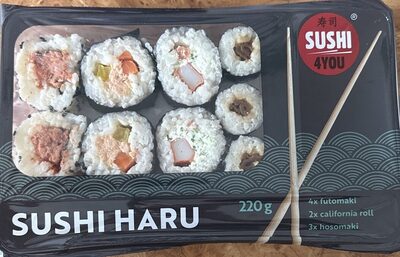
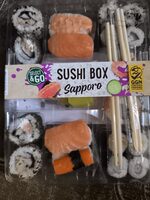
View full-size photo · Photo: Open Food Facts contributors, CC BY-SA
Sushi Haru
Sushi Haru by Sushi 4 you provides 144 kcal per 100 g, with 5.1 g of sugars and 3.4 g of protein. That is 13% more sugar than the average product in this category. Its Nutri-Score is C and it is classified as NOVA 4 (ultra-processed food). It is listed in the Sushis category. Contains: crustaceans, eggs, fish, gluten, milk, mustard, soybeans.
Nutrient levels per 100 g
Levels use UK front-of-pack reference thresholds.
Nutrition facts
| Nutrient | Per 100 g | Category avg |
|---|---|---|
| Calories | 144 kcal | 161 −11% |
| Total fat | 3.3 g | 4.7 −30% |
| Saturated fat | 0.6 g | 0.9 −36% |
| Carbohydrates | 24 g | 23.7 |
| Total sugars | 5.1 g | 4.5 +13% |
| Added sugars | 3.8 g | 5.3 −29% |
| Protein | 3.4 g | 6 −43% |
| Salt | 1.8 g | 1.2 +45% |
*% Daily Value for 100 g, based on a 2,000-calorie diet (FDA reference values). Category average across 847 Sushis products on Foodmetria.
Compared with other sushis
Bar shows the share of products in this category that contain less of the nutrient.
Ingredients
74,7% gotowany ryż, w zalewie (woda, ryż, cukier, olej rzepakowy, ocet spirytusowy, sól, naturalny aromat (zawiera skorupiaki), olej rzepakowy, regulator kwasowości: octan sodu), 4,5% pikantna sałatka z surimi [57,1% surimi (48% ryby, woda, skrobia pszenna, cukier, sól, naturalny aromat (zawiera skorupiaki), olej rzepakowy, białko jaja w proszku, ekstrakt z papryki, serek śmietankowy (mleko, śmietanka, kultury bakterii mlekowych, podpuszczka mikrobiologiczna, białka mleka, sól), koncentrat pomidorowy, sos sojowy (woda, nasiona soi, pszenica, sól)], 2,3% imbir marynowany (66,7% imbir, woda, sól, regulatory kwasowości: kwas cytrynowy; substancja konserwująca: sorbinian potasu; substancje słodzące: aspartam, sukraloza, sacharynian sodu), 2,3% łosoś atlantycki pieczony, 1,8% serek śmietankowy z imitacją kawioru z alg morskich o smaku wasabi (61% ekstrakt z alg morskich, syrop cukru inwertowanego, olej rzepakowy, sól, aromat, regulator kwasowości: kwas cytrynowy, kurkumina), 1,6% sos chrzanowy o smaku wasabi (woda, 18% chrzan w proszku, błonnik grochowy i chlorofili, naturalne aromaty papryki i gorczycy, 0,02% wasabi w proszku, barwniki: kurkumina, kompleksy miedziowe chlorofili i chlorofilin; gorczyca w proszku, ocet spirytusowy, kwas cytrynowy), 1,4% sos majonezowo-imbirowy [87% majonez (olej rzepakowy, woda, żółtko jaja w proszku, ocet spirytusowy, mączka z gorczycy, cukier, sól, przyprawy)], 13% imbir marynowany (imbir, cukier, woda, sól, kwasy: kwas octowy, kwas cytrynowy)], 1,4% tykwa marynowana (tykwa, syrop glukozowo-fruktozowy, woda, sos sojowy (woda, soja, pszenica, sól), cukier, sól, regulatory kwasowości: kwas jabłkowy, kwas cytrynowy; wzmacniacz smaku: glutaminian monosodowy], 1,2% rzodkiew marynowana (rzodkiew, ocet ryżowy, cukier, sól, kurkuma), algi morskie prażone nori, 0,2% nasiona sezamu czarnego, skrobia. Zawiera źródło fenyloalaniny. Może zawierać: seler, mięczaki, orzeszki ziemne i orzechy.
- Allergens
- CrustaceansEggsFishGlutenMilkMustardSoybeans
- May contain traces
- CeleryMolluscsNutsPeanuts
Additives 13
Overexposure risk is based on EFSA evaluations as recorded by Open Food Facts.
Product details
- Sold in
- Poland
- Barcode
- 5905386404426
Prices reported by shoppers
Loading prices…
Frequently asked questions
How many calories are in Sushi Haru?
Sushi Haru contains 144 kcal per 100 g.
How much sugar is in Sushi Haru?
Sushi Haru has 5.1 g of sugars per 100 g, which is considered moderate by UK front-of-pack guidelines.
Is Sushi Haru healthy?
It has a Nutri-Score of C (A is best, E is worst); it is in NOVA group 4 — ultra-processed food. Scores describe nutritional quality and processing, not suitability for your individual diet.
Is Sushi Haru vegan?
Based on its ingredient list, it is not vegan.
What allergens does Sushi Haru contain?
According to the label data it contains: Crustaceans, Eggs, Fish, Gluten, Milk, Mustard, Soybeans. It may also contain traces of celery, molluscs, nuts, peanuts. Recipes change — always check the package label.
Source: Open Food Facts (ODbL). Last updated June 16, 2026. Spotted a mistake? Edit this product on Open Food Facts. Not medical advice — always check the package label.
Reviews
Compare & rankings
Healthier alternatives
Best in category →Same category, meaningfully better on at least one measure and no worse on the others. Each card shows what improves.
 a
a  b NOVA 3
  b
b  a NOVA 4
 More sushis
View all → d NOVA 4
  c NOVA 4
  a
a  c NOVA 4
  c NOVA 4
  c
c 