
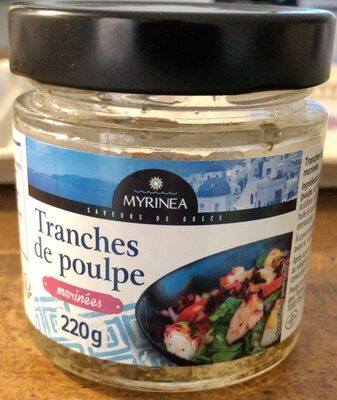
View full-size photo · Photo: Open Food Facts contributors, CC BY-SA
Tranches de poulpe
Tranches de poulpe provides 153 kcal per 100 g, with 0.5 g of sugars and 23.3 g of protein. That is 46% less sugar than the average product in this category. Its Nutri-Score is D. It is listed in the Common octopus category.
Nutrient levels per 100 g
Levels use UK front-of-pack reference thresholds.
Nutrition facts
| Nutrient | Per 100 g | Category avg |
|---|---|---|
| Calories | 153 kcal | 156 |
| Total fat | 6.6 g | 9.1 −27% |
| Saturated fat | 5.4 g | 1.3 +331% |
| Carbohydrates | 1 g | 2.3 −57% |
| Total sugars | 0.5 g | 0.9 −46% |
| Protein | 23.3 g | 16.4 +42% |
| Salt | 2.4 g | 1.5 +61% |
*% Daily Value for 100 g, based on a 2,000-calorie diet (FDA reference values). Category average across 159 Common octopus products on Foodmetria.
Compared with other common octopus
Bar shows the share of products in this category that contain less of the nutrient.
Product details
- Sold in
- France
- Barcode
- 2006050031863
Prices reported by shoppers
Loading prices…
Frequently asked questions
How many calories are in Tranches de poulpe?
Tranches de poulpe contains 153 kcal per 100 g.
How much sugar is in Tranches de poulpe?
Tranches de poulpe has 0.5 g of sugars per 100 g, which is considered low by UK front-of-pack guidelines.
Is Tranches de poulpe healthy?
It has a Nutri-Score of D (A is best, E is worst). Scores describe nutritional quality and processing, not suitability for your individual diet.
Source: Open Food Facts (ODbL). Last updated March 25, 2026. Spotted a mistake? Edit this product on Open Food Facts. Not medical advice — always check the package label.
Reviews
Compare & rankings
Healthier alternatives
Best in category →Same category, meaningfully better on at least one measure and no worse on the others. Each card shows what improves.
 a
a  a
a  a NOVA 3
  a
a More common octopus
View all → d NOVA 4
  a NOVA 4
  a
a  a NOVA 3
  a NOVA 3
  b NOVA 4