
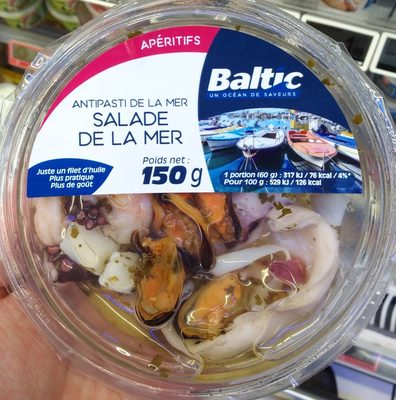
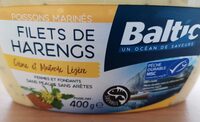
View full-size photo · Photo: Open Food Facts contributors, CC BY-SA
Salade de la mer
Salade de la mer by Baltic provides 126 kcal per 100 g, with 0.5 g of sugars and 15 g of protein. That is 78% less sugar than the average product in this category. Its Nutri-Score is C and it is classified as NOVA 4 (ultra-processed food). It is listed in the Refrigerated meals category and comes in a 150 g (120 g égoutté) pack. Contains: crustaceans, molluscs, sulphur dioxide and sulphites.
Nutrient levels per 100 g
Levels use UK front-of-pack reference thresholds.
Nutrition facts
Serving size: 60 g
| Nutrient | Per 100 g | Per serving | % DV* | Category avg |
|---|---|---|---|---|
| Calories | 126 kcal | 76 kcal | 174 −28% | |
| Total fat | 5.9 g | 3.5 g | 4% | 9.1 −35% |
| Saturated fat | 0.7 g | 0.4 g | 2% | 2.9 −76% |
| Carbohydrates | 3.8 g | 2.3 g | 1% | 14.6 −74% |
| Total sugars | 0.5 g | 0.3 g | 2.3 −78% | |
| Added sugars | 0 g | 0 g | 0% | 0.6 −100% |
| Dietary fiber | 0 g | 0 g | 0% | 2 −100% |
| Protein | 15 g | 9 g | 18% | 7.7 +95% |
| Salt | 1.9 g | 1.1 g | 1 +82% |
*% Daily Value for a serving, based on a 2,000-calorie diet (FDA reference values). Category average across 342 Refrigerated meals products on Foodmetria.
Compared with other refrigerated meals
Bar shows the share of products in this category that contain less of the nutrient.
Ingredients
_Encornets_ 45 % (Dosidicus gigas, pêché en FAO zone 87.1 Océan Pacifique Sud-Est par ligne et hameçons), _poulpes_ 20 % (Octopus maya pêché en FAO 31 Atlantique Centre-Est et Octopus vulgaris pêché en FAO 34 par chalut), _moules_ 20 % (Mytilus galloprovincilis élevé en aquaculture Espagne et Mytilus chilensis élevé en aquaculture Chili), huile de tournesol, _seiches_ 10 % (Sepia aculeata pêché en FAO 51 Est Océan Indien par chalut), _crevettes_ 5 % (Penaeus vannamei élevé en aquaculture Vietnam), persil, vinaigre de vin (_sulfites_), sel, fructose, acidifiant : acide lactique, antioxydant : acide ascorbique, conservateur : sorbate de potassium, arôme naturel.
- Allergens
- CrustaceansMolluscsSulphur dioxide and sulphites
- May contain traces
- CeleryEggsFishGlutenSoybeans
Additives 3
Overexposure risk is based on EFSA evaluations as recorded by Open Food Facts.
Product details
- Quantity
- 150 g (120 g égoutté)
- Serving size
- 60 g
- Labels & certifications
- Sustainablefishing methodSustainable fisherySustainable fishing methodAngled fishGreen DotMade in ItalyTrawl fishing
- Sold in
- France
- Barcode
- 3052420133599
Prices reported by shoppers
Loading prices…
Frequently asked questions
How many calories are in Salade de la mer?
Salade de la mer contains 126 kcal per 100 g and about 76 kcal per serving (60 g).
How much sugar is in Salade de la mer?
Salade de la mer has 0.5 g of sugars per 100 g, which is considered low by UK front-of-pack guidelines.
Is Salade de la mer healthy?
It has a Nutri-Score of C (A is best, E is worst); it is in NOVA group 4 — ultra-processed food. Scores describe nutritional quality and processing, not suitability for your individual diet.
Is Salade de la mer vegan?
Based on its ingredient list, it is not vegan.
What allergens does Salade de la mer contain?
According to the label data it contains: Crustaceans, Molluscs, Sulphur dioxide and sulphites. It may also contain traces of celery, eggs, fish, gluten, soybeans. Recipes change — always check the package label.
Source: Open Food Facts (ODbL). Last updated March 17, 2026. Spotted a mistake? Edit this product on Open Food Facts. Not medical advice — always check the package label.
Reviews
Compare & rankings
Healthier alternatives
Best in category →Same category, meaningfully better on at least one measure and no worse on the others. Each card shows what improves.
 a NOVA 3
  a NOVA 4
  b
b  b NOVA 4
 More refrigerated meals
View all → c NOVA 3
  c NOVA 3
  c NOVA 4
  c NOVA 3
  c NOVA 3
  d NOVA 3
 More from Baltic
View all →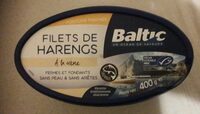 d NOVA 4
  e NOVA 4
  b
b  d NOVA 4
  d NOVA 4
  e NOVA 4