
Philadelphia vs Roomkaas Garlan
Overall, Philadelphia has the better nutritional profile on the measures we compare. It wins on 6 of our comparison points versus 2.
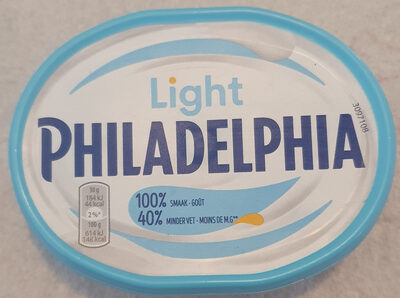

Nutrition per 100 g
| Nutrient | Philadelphia | Roomkaas Garlan |
|---|---|---|
| Nutri-Score | c | d |
| NOVA group | 4 | 4 |
| Calories | 145 kcal | 267 kcal |
| Fat | 10 g | 26 g |
| Saturated fat | 6.9 g | 17 g |
| Sugars | 5.1 g | 2.8 g |
| Salt | 0.1 g | 0 g |
| Fiber | 0.3 g | 1 g |
| Protein | 7.2 g | 4.8 g |
| Additives | 2 | 0 |
| Allergens | Milk | Milk, Mustard |
Green = better value for that nutrient (less sugar, fat, salt and calories; more fiber and protein).
Key differences
- Philadelphia has 46% fewer calories (145 kcal vs 267 kcal).
- Philadelphia has 62% less fat (10 g vs 26 g).
- Philadelphia has 59% less saturated fat (6.9 g vs 17 g).
- Roomkaas Garlan has 45% less sugar (2.8 g vs 5.1 g).
- Roomkaas Garlan has 69% more fiber (1 g vs 0.3 g).
- Philadelphia has 33% more protein (7.2 g vs 4.8 g).
- Philadelphia has the better Nutri-Score.
- Only Roomkaas Garlan lists: Mustard.
Ingredients
Philadelphia
Volle melk, melkeiwittenbereiding, room weipermeaatconcentraat (van melk), zout, stabilisatoren (iohannesbroodpitmeel, carrageen), voedingszuur (citroenzuur). Van gepasteuriseerde melk.
Roomkaas Garlan
Magere MELK, ROOM, zout, BOTER, 0.2% kruiden (peterselie, basilicum), 0.2% knoflookextract (tapioca, maltodextrine, palmpitvet, WEIPOEDER, knoflookolie), 0.1% mierikswortelbereiding (mierikswortel, water, koolzaadolie, zout), 0.1% knoflookgranulaat, azijn, witte peper, zuursel (MELK)
FAQ
Which is healthier: Philadelphia or Roomkaas Garlan?
Overall, Philadelphia has the better nutritional profile on the measures we compare. We compare Nutri-Score, processing level and seven nutrients per 100 g. Your own needs (for example low sugar or high protein) may make a different choice better for you.
Which has fewer calories?
Philadelphia has fewer calories: 145 kcal versus 267 kcal per 100 g.
Which has less sugar?
Roomkaas Garlan has less sugar: 2.8 g versus 5.1 g per 100 g.