
Cheddar & onion vs Walkers Cheese & Onion crisps
Overall, Cheddar & onion has the better nutritional profile on the measures we compare. It wins on 2 of our comparison points versus 1.
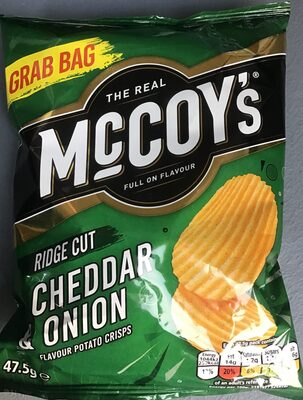
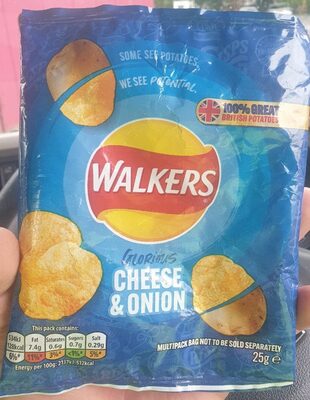
Nutrition per 100 g
| Nutrient | Cheddar & onion | Walkers Cheese & Onion crisp... |
|---|---|---|
| Nutri-Score | c | d |
| NOVA group | 4 | 4 |
| Calories | 530 kcal | 512 kcal |
| Fat | 30 g | 29 g |
| Saturated fat | 2.8 g | 2.4 g |
| Sugars | 2.6 g | 2.8 g |
| Salt | 1 g | 1.2 g |
| Fiber | 4.4 g | 4 g |
| Protein | 7.4 g | 6.8 g |
| Additives | 1 | 8 |
| Allergens | Milk | Milk |
Green = better value for that nutrient (less sugar, fat, salt and calories; more fiber and protein).
Key differences
- Walkers Cheese & Onion crisps has 14% less saturated fat (2.4 g vs 2.8 g).
- Cheddar & onion has the better Nutri-Score.
Ingredients
Cheddar & onion
Potatoes, Sunflower Oil, Cheddar & Onion. Flavour [Dried Onion, Dried Yeast Extract, Dried Whey (MILK), Dextrose, Salt, Dried Whole MILK, Dried Cheese (MILK), Rubbed Parsley, Flavourings (contains MILK), Onion Extract, Colour: Paprika Extract].
Walkers Cheese & Onion crisps
Potatoes, Vegetable Oils (Sunflower, Rapeseed, in varying proportions), Cheese & Onion Seasoning [Dried Onion, Salt, Dried Milk Whey, Lactose (from Milk), Sugar, Flavouring (contains Milk), Cheese Powder (from Milk), Dried Yeast, Acids (Citric Acid, Malic Acid), Whey Protein (from Milk), Dried Garlic, Colours (Annatto Bixin, Paprika Extract)], Antioxidants (Rosemary Extract, Ascorbic Acid, Tocopherol Rich Extract, Citric Acid).
FAQ
Which is healthier: Cheddar & onion or Walkers Cheese & Onion crisps?
Overall, Cheddar & onion has the better nutritional profile on the measures we compare. We compare Nutri-Score, processing level and seven nutrients per 100 g. Your own needs (for example low sugar or high protein) may make a different choice better for you.
Which has fewer calories?
Walkers Cheese & Onion crisps has fewer calories: 512 kcal versus 530 kcal per 100 g.
Which has less sugar?
Cheddar & onion has less sugar: 2.6 g versus 2.8 g per 100 g.