
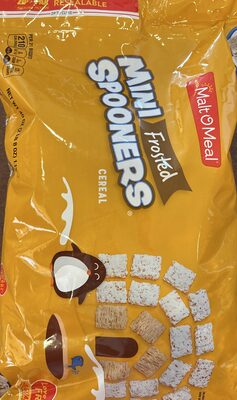
Mini frosted Spooners vs Cheerios
Overall, Mini frosted Spooners has the better nutritional profile on the measures we compare. It wins on 4 of our comparison points versus 3.

Nutrition per 100 g
| Nutrient | Mini frosted Spooners | Cheerios |
|---|---|---|
| Nutri-Score | b | b |
| NOVA group | 4 | 4 |
| Calories | 350 kcal | 300 kcal |
| Fat | 1.7 g | 12.9 g |
| Saturated fat | 0 g | 1.4 g |
| Sugars | 20 g | 2.9 g |
| Salt | 0 g | 1.1 g |
| Fiber | 10 g | 2.9 g |
| Protein | 8.3 g | 22.9 g |
| Additives | 1 | 5 |
| Allergens | Gelatin, Gluten | Eggs, Gluten, Milk, Soybeans |
Green = better value for that nutrient (less sugar, fat, salt and calories; more fiber and protein).
Key differences
- Cheerios has 14% fewer calories (300 kcal vs 350 kcal).
- Mini frosted Spooners has 87% less fat (1.7 g vs 12.9 g).
- Mini frosted Spooners has no saturated fat, while Cheerios has 1.4 g.
- Cheerios has 86% less sugar (2.9 g vs 20 g).
- Mini frosted Spooners has 98% less salt (0 g vs 1.1 g).
- Mini frosted Spooners has 71% more fiber (10 g vs 2.9 g).
- Cheerios has 64% more protein (22.9 g vs 8.3 g).
- Only Mini frosted Spooners lists: Gelatin.
- Only Cheerios lists: Eggs, Milk, Soybeans.
Ingredients
Mini frosted Spooners
Whole Grain Wheat, Sugar, Gelatin, Reduced Iron, Niacinamide (Vitamin B3), Folic Acid, Zinc Oxide, Pyridoxine Hydrochloride (Vitamin B6), Riboflavin (Vitamin B2), Thiamin Mononitrate (Vitamin B1), Vitamin B12. CONTAINS WHEAT.
Cheerios
Ainer es (70g) 100% whole grain wheat flour, water, wheat protein isolate, eggs, canola oil, whey protein isolate, buttermilk, 100% whole grain oat 210 flour, sunflower lecithin, egg whites, date powder, leavening (sodium Daily Value acid pyrophosphate, baking soda), 12% natural flavors, sea salt. 5% Contains egg, milk, soy, and wheat. 8% 13% 6% 7% ars 0% 16% 0% 4% 8% Created &
FAQ
Which is healthier: Mini frosted Spooners or Cheerios?
Overall, Mini frosted Spooners has the better nutritional profile on the measures we compare. We compare Nutri-Score, processing level and seven nutrients per 100 g. Your own needs (for example low sugar or high protein) may make a different choice better for you.
Which has fewer calories?
Cheerios has fewer calories: 300 kcal versus 350 kcal per 100 g.
Which has less sugar?
Cheerios has less sugar: 2.9 g versus 20 g per 100 g.