
Italian Diced Pancetta vs Pancetta finement tranchée
Overall, Pancetta finement tranchée has the better nutritional profile on the measures we compare. It wins on 3 of our comparison points versus 2.

Italian Diced Pancetta
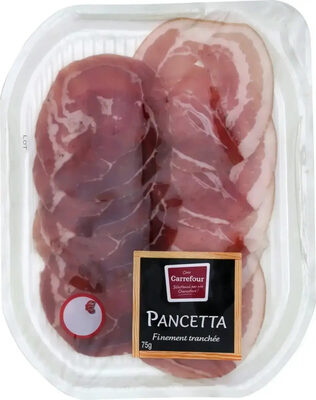
Pancetta finement tranchée
Nutrition per 100 g
| Nutrient | Italian Diced Pancetta | Pancetta finement tranchée |
|---|---|---|
| Nutri-Score | — | e |
| NOVA group | 4 | 4 |
| Calories | 328 kcal | 282 kcal |
| Fat | 28.4 g | 21 g |
| Saturated fat | 10.6 g | 10 g |
| Sugars | 0.5 g | 0.6 g |
| Salt | 0.2 g | 3.5 g |
| Fiber | 0.5 g | 0 g |
| Protein | 17 g | 22 g |
| Additives | 1 | 3 |
| Allergens | None listed | None listed |
Green = better value for that nutrient (less sugar, fat, salt and calories; more fiber and protein).
Key differences
- Pancetta finement tranchée has 14% fewer calories (282 kcal vs 328 kcal).
- Pancetta finement tranchée has 26% less fat (21 g vs 28.4 g).
- Italian Diced Pancetta has 95% less salt (0.2 g vs 3.5 g).
- Italian Diced Pancetta has 100% more fiber (0.5 g vs 0 g).
- Pancetta finement tranchée has 23% more protein (22 g vs 17 g).
Ingredients
Italian Diced Pancetta
Pork Belly, Salt, Flavouring, Preservative (Sodium Nitrite).
Pancetta finement tranchée
Poitrine de porc, sel, dextrose, l_actose_, vin blanc, épices, eau de vie de vin, ail, arômes, conservateurs : nitrate de potassium et nitrite de sodium, antioxydant : ascorbate de sodium, ferments. Viande de porc origine Union Européenne. Peut contenir des traces de fruits à coque, oeuf, moutarde.
FAQ
Which is healthier: Italian Diced Pancetta or Pancetta finement tranchée?
Overall, Pancetta finement tranchée has the better nutritional profile on the measures we compare. We compare Nutri-Score, processing level and seven nutrients per 100 g. Your own needs (for example low sugar or high protein) may make a different choice better for you.
Which has fewer calories?
Pancetta finement tranchée has fewer calories: 282 kcal versus 328 kcal per 100 g.
Which has less sugar?
Italian Diced Pancetta has less sugar: 0.5 g versus 0.6 g per 100 g.