
Gratin dauphinois vs Gratin dauphinois
Neither product is clearly better overall — it depends on what matters most to you.
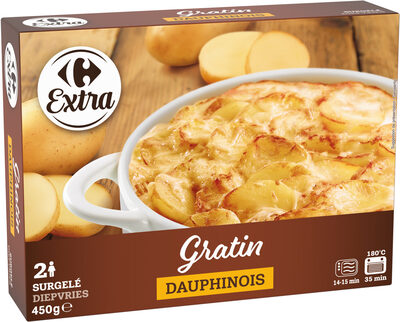
Nutrition per 100 g
| Nutrient | Gratin dauphinois | Gratin dauphinois |
|---|---|---|
| Nutri-Score | c | c |
| NOVA group | 4 | 4 |
| Calories | 133 kcal | 126 kcal |
| Fat | 8.2 g | 7.5 g |
| Saturated fat | 4.7 g | 3.7 g |
| Sugars | 1.9 g | 0.9 g |
| Salt | 0.5 g | 0.5 g |
| Fiber | 1.6 g | 0.5 g |
| Protein | 3.8 g | 2.8 g |
| Additives | 1 | 1 |
| Allergens | Eggs, Gluten, Milk | Eggs, Gluten, Milk |
Green = better value for that nutrient (less sugar, fat, salt and calories; more fiber and protein).
Key differences
- Gratin dauphinois has 21% less saturated fat (3.7 g vs 4.7 g).
- Gratin dauphinois has 53% less sugar (0.9 g vs 1.9 g).
- Gratin dauphinois has 69% more fiber (1.6 g vs 0.5 g).
- Gratin dauphinois has 26% more protein (3.8 g vs 2.8 g).
Ingredients
Gratin dauphinois
Pommes de terre précuites 52,9%, eau, crème fraîche (contient _lait_) 13,5%, emmental (contient _lait_) 6,1%, _lait_ écrémé en poudre, ail, huile de tournesol, farine de _blé_, amidon de riz, sel, arôme naturel d'ail, épaississant : gomme xanthane, muscade, curcuma. Peut contenir des traces d'autres céréales contenant du gluten, d'œufs, de céleri ainsi que leurs dérivés.
Gratin dauphinois
Pomme de terre précuite [pomme de terre 55,4% (Belgique), sel], _lait_ demi-écrémé, crème liquide 13,9% (_lait_), emmental râpé 8,6% (Pays-Bas, contient _lait_), fromage frais (contient _lait_), amidon transformé de pomme de terre, amidon de riz, farine de blé (_gluten_), sel, jaune d'_œuf_ en poudre, muscade, ail en poudre, poivre, ail.
FAQ
Which is healthier: Gratin dauphinois or Gratin dauphinois?
Neither product is clearly better overall — it depends on what matters most to you. We compare Nutri-Score, processing level and seven nutrients per 100 g. Your own needs (for example low sugar or high protein) may make a different choice better for you.
Which has fewer calories?
Gratin dauphinois has fewer calories: 126 kcal versus 133 kcal per 100 g.
Which has less sugar?
Gratin dauphinois has less sugar: 0.9 g versus 1.9 g per 100 g.