
Butter vs Balade So light
Overall, Balade So light has the better nutritional profile on the measures we compare. It wins on 6 of our comparison points versus 2.
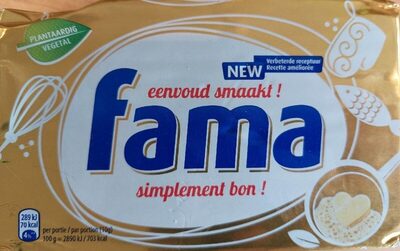
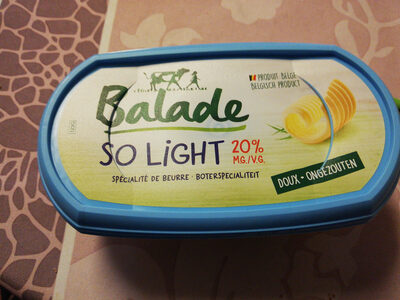
Nutrition per 100 g
| Nutrient | Butter | Balade So light |
|---|---|---|
| Nutri-Score | e | d |
| NOVA group | 4 | 4 |
| Calories | 703 kcal | 212 kcal |
| Fat | 78 g | 20 g |
| Saturated fat | 30 g | 12.7 g |
| Sugars | 0.5 g | 2.2 g |
| Salt | 1.5 g | 0.5 g |
| Fiber | 0 g | 0 g |
| Protein | 0.5 g | 0.2 g |
| Additives | 5 | 6 |
| Allergens | Milk | Milk |
Green = better value for that nutrient (less sugar, fat, salt and calories; more fiber and protein).
Key differences
- Balade So light has 70% fewer calories (212 kcal vs 703 kcal).
- Balade So light has 74% less fat (20 g vs 78 g).
- Balade So light has 58% less saturated fat (12.7 g vs 30 g).
- Butter has 77% less sugar (0.5 g vs 2.2 g).
- Balade So light has 67% less salt (0.5 g vs 1.5 g).
- Butter has 60% more protein (0.5 g vs 0.2 g).
- Balade So light has the better Nutri-Score.
Ingredients
Butter
vegetable oils and fats (palm; rapeseed; coconut; in varying proportions); water; salt (1.5%); emulsifier (lecithins; E471); sweet whey powder (MILK); preservative (E202); acid (citric acid); flavouring; flavouring (MILK); colour (carotenes); vitamins (vitamin A; vitamin D).Total fat content : 78 %.
Balade So light
eau, matière grasse de _lait_, amidon modifié, maltodextrine, arômes naturels, _lactose_,émulsifiants (E471, E476), protéines de _lait_, sel, conservateur (sorbate de potassium), colorant (béta-carotène), vitamine E, vitamine A.
FAQ
Which is healthier: Butter or Balade So light?
Overall, Balade So light has the better nutritional profile on the measures we compare. We compare Nutri-Score, processing level and seven nutrients per 100 g. Your own needs (for example low sugar or high protein) may make a different choice better for you.
Which has fewer calories?
Balade So light has fewer calories: 212 kcal versus 703 kcal per 100 g.
Which has less sugar?
Butter has less sugar: 0.5 g versus 2.2 g per 100 g.