
Boudin à l'ancienne aux oignons frais vs 2 Boudins noirs aux pommes (cuits, congelés)
Neither product is clearly better overall — it depends on what matters most to you.

Boudin à l'ancienne aux oignons frais
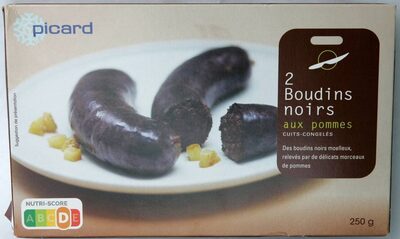
2 Boudins noirs aux pommes (cuits, congelés)
Nutrition per 100 g
| Nutrient | Boudin à l'ancienne aux oign... | 2 Boudins noirs aux pommes (... |
|---|---|---|
| Nutri-Score | d | d |
| NOVA group | 3 | 3 |
| Calories | 231 kcal | 255 kcal |
| Fat | 19 g | 20 g |
| Saturated fat | 7.4 g | 7.8 g |
| Sugars | 3 g | 6.9 g |
| Salt | 1.5 g | 1.4 g |
| Fiber | 0 g | 1.8 g |
| Protein | 11 g | 10 g |
| Additives | 0 | 0 |
| Allergens | None listed | None listed |
Green = better value for that nutrient (less sugar, fat, salt and calories; more fiber and protein).
Key differences
- Boudin à l'ancienne aux oignons frais has 57% less sugar (3 g vs 6.9 g).
- 2 Boudins noirs aux pommes (cuits, congelés) has 100% more fiber (1.8 g vs 0 g).
Ingredients
Boudin à l'ancienne aux oignons frais
Sang de porc, oignons 37%, gras de porc, couenne de porc sel, sucre, épices, plantes aromatiques, boyau naturel de porc
2 Boudins noirs aux pommes (cuits, congelés)
Sang de porc (origine: France*), oignon cuit (oignon 24,1%, oignon déshydraté), gras de porc (origine: France*), pomme au caramel cuite (pomme 8,3%, caramel (sucre, eau), sucre liquide, alcoolat de pomme (pomme, alcool), jus concentré de pomme), couenne cuite (origine: France*), sel, épices et plantes aromatiques, boyau naturel de porc.
FAQ
Which is healthier: Boudin à l'ancienne aux oignons frais or 2 Boudins noirs aux pommes (cuits, congelés)?
Neither product is clearly better overall — it depends on what matters most to you. We compare Nutri-Score, processing level and seven nutrients per 100 g. Your own needs (for example low sugar or high protein) may make a different choice better for you.
Which has fewer calories?
Boudin à l'ancienne aux oignons frais has fewer calories: 231 kcal versus 255 kcal per 100 g.
Which has less sugar?
Boudin à l'ancienne aux oignons frais has less sugar: 3 g versus 6.9 g per 100 g.