
Wiltshire cured apple wood smoked ham vs British Peppered Ham
Neither product is clearly better overall — it depends on what matters most to you.
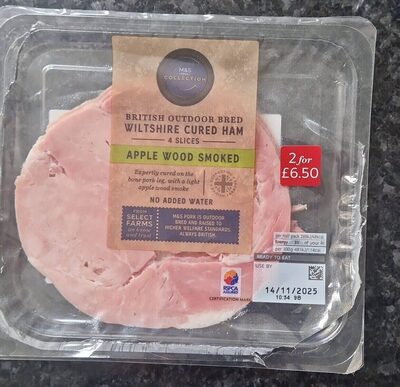
Wiltshire cured apple wood smoked ham
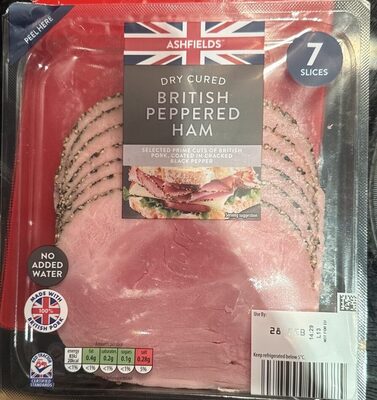
British Peppered Ham
Nutrition per 100 g
| Nutrient | Wiltshire cured apple wood s... | British Peppered Ham |
|---|---|---|
| Nutri-Score | d | c |
| NOVA group | 4 | 4 |
| Calories | 114 kcal | 114 kcal |
| Fat | 1.8 g | 2.6 g |
| Saturated fat | 0.6 g | 0.9 g |
| Sugars | 0.1 g | 0.4 g |
| Salt | 2.3 g | 1.6 g |
| Fiber | 1 g | — |
| Protein | 24.3 g | 22.1 g |
| Additives | 5 | 3 |
| Allergens | None listed | Pork |
Green = better value for that nutrient (less sugar, fat, salt and calories; more fiber and protein).
Key differences
- Wiltshire cured apple wood smoked ham has 31% less fat (1.8 g vs 2.6 g).
- Wiltshire cured apple wood smoked ham has 33% less saturated fat (0.6 g vs 0.9 g).
- Wiltshire cured apple wood smoked ham has 75% less sugar (0.1 g vs 0.4 g).
- British Peppered Ham has 30% less salt (1.6 g vs 2.3 g).
- British Peppered Ham has the better Nutri-Score.
- Only British Peppered Ham lists: Pork.
Ingredients
Wiltshire cured apple wood smoked ham
Porc d'origine britannique (fait avec 120 g de porc cru pour 100 g de jambon du Wiltshire traité en salaison, fumé et pané) - Gélatine de porc - Sels de salaison (Sel - Conservateur: Nitrite de sodium, Nitrate de potassium) - Farine de riz - Farine de maïs - Colorant: Extrait de paprika, Curcumine - Huile de colza - Dextrose.
British Peppered Ham
Pork (98%), Salt, Sugar, Stabiliser: Triphosphates; Natural Mineral Salt, Black Pepper, Antioxidant: Sodium Ascorbate; Preservative: Sodium Nitrite
FAQ
Which is healthier: Wiltshire cured apple wood smoked ham or British Peppered Ham?
Neither product is clearly better overall — it depends on what matters most to you. We compare Nutri-Score, processing level and seven nutrients per 100 g. Your own needs (for example low sugar or high protein) may make a different choice better for you.
Which has fewer calories?
Wiltshire cured apple wood smoked ham has fewer calories: 114 kcal versus 114 kcal per 100 g.
Which has less sugar?
Wiltshire cured apple wood smoked ham has less sugar: 0.1 g versus 0.4 g per 100 g.