
M&M's vs Karamel milka
Overall, M&M's has the better nutritional profile on the measures we compare. It wins on 3 of our comparison points versus 2.
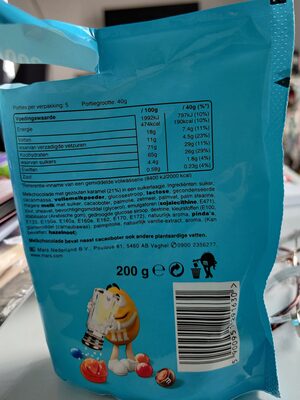
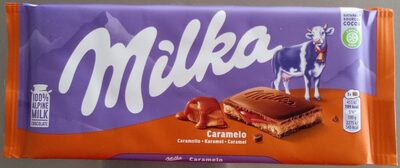
Nutrition per 100 g
| Nutrient | M&M's | Karamel milka |
|---|---|---|
| Nutri-Score | e | e |
| NOVA group | 4 | 4 |
| Calories | 474 kcal | 545 kcal |
| Fat | 18 g | 33 g |
| Saturated fat | 11 g | 19 g |
| Sugars | 65 g | 51 g |
| Salt | 0.6 g | 0.3 g |
| Fiber | — | 1.2 g |
| Protein | 4.4 g | 4.3 g |
| Additives | 13 | 1 |
| Allergens | Milk, Peanuts, Soybeans | Milk, Nuts, Soybeans |
Green = better value for that nutrient (less sugar, fat, salt and calories; more fiber and protein).
Key differences
- M&M's has 13% fewer calories (474 kcal vs 545 kcal).
- M&M's has 45% less fat (18 g vs 33 g).
- M&M's has 42% less saturated fat (11 g vs 19 g).
- Karamel milka has 22% less sugar (51 g vs 65 g).
- Karamel milka has 54% less salt (0.3 g vs 0.6 g).
- Only M&M's lists: Peanuts.
- Only Karamel milka lists: Nuts.
Ingredients
M&M's
suiker, cacaomassa, vollemelkpoeder, glucosestroop, lactose, gecondenseerde magere melk met suiker, cacaoboter, palmolie, zetmeel, palmvet, palm stearine, zout, sheavet, bevochtigingsmiddel (glycerol), emulgatoren (sojalecithine, E471), stabilisator (Arabische gom), gedroogde glucose siroop, dextrine, kleurstoffen (E100, E133, E150a, E160a, E160e, E162, E170, E172), natuurlijk aroma, pinda's, glansmiddel (carnaubawas), palmpitolie, natuurlijk vanille-extract, aroma,
Karamel milka
Suiker, palmvet, cacaoboter, weipoeder (van _melk_), magere _melkpoeder_, glucosestroop, cacaomassa, _melkvet_, glucose-fructosestroop, emulgatoren (_sojalecithinen_, E471), _hazelnootpasta_, aroma's, zout.
FAQ
Which is healthier: M&M's or Karamel milka?
Overall, M&M's has the better nutritional profile on the measures we compare. We compare Nutri-Score, processing level and seven nutrients per 100 g. Your own needs (for example low sugar or high protein) may make a different choice better for you.
Which has fewer calories?
M&M's has fewer calories: 474 kcal versus 545 kcal per 100 g.
Which has less sugar?
Karamel milka has less sugar: 51 g versus 65 g per 100 g.