
Fruity Cheerios vs Cheerios
Overall, Cheerios has the better nutritional profile on the measures we compare. It wins on 5 of our comparison points versus 3.
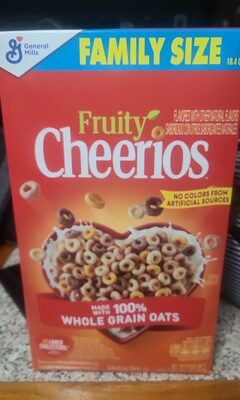

Nutrition per 100 g
| Nutrient | Fruity Cheerios | Cheerios |
|---|---|---|
| Nutri-Score | d | b |
| NOVA group | 4 | 4 |
| Calories | 389 kcal | 300 kcal |
| Fat | 5.6 g | 12.9 g |
| Saturated fat | 0 g | 1.4 g |
| Sugars | 33.3 g | 2.9 g |
| Salt | 1 g | 1.1 g |
| Fiber | 8.3 g | 2.9 g |
| Protein | 8.3 g | 22.9 g |
| Additives | 3 | 5 |
| Allergens | None listed | Eggs, Gluten, Milk, Soybeans |
Green = better value for that nutrient (less sugar, fat, salt and calories; more fiber and protein).
Key differences
- Cheerios has 23% fewer calories (300 kcal vs 389 kcal).
- Fruity Cheerios has 57% less fat (5.6 g vs 12.9 g).
- Fruity Cheerios has no saturated fat, while Cheerios has 1.4 g.
- Cheerios has 91% less sugar (2.9 g vs 33.3 g).
- Fruity Cheerios has 66% more fiber (8.3 g vs 2.9 g).
- Cheerios has 64% more protein (22.9 g vs 8.3 g).
- Cheerios has the better Nutri-Score.
- Only Cheerios lists: Eggs, Gluten, Milk, Soybeans.
Ingredients
Fruity Cheerios
Whole Grain Oats, Sugar, Corn Syrup, Corn Starch, Pear Puree, Salt, Color (fruit and vegetable juice, annatto extract), Tripotassium Phosphate, Natural Flavor, Vitamin E (mixed tocopherols), Calcium Carbonate, Vitamin C (sodium ascorbate), Iron, Zinc, Niacinamide, Pyridoxine Hydrochloride, Thiamin Mononitrate, Palmitate, Riboflavin, Folic Acid, Vitamin B12, Vitamin D.
Cheerios
Ainer es (70g) 100% whole grain wheat flour, water, wheat protein isolate, eggs, canola oil, whey protein isolate, buttermilk, 100% whole grain oat 210 flour, sunflower lecithin, egg whites, date powder, leavening (sodium Daily Value acid pyrophosphate, baking soda), 12% natural flavors, sea salt. 5% Contains egg, milk, soy, and wheat. 8% 13% 6% 7% ars 0% 16% 0% 4% 8% Created &
FAQ
Which is healthier: Fruity Cheerios or Cheerios?
Overall, Cheerios has the better nutritional profile on the measures we compare. We compare Nutri-Score, processing level and seven nutrients per 100 g. Your own needs (for example low sugar or high protein) may make a different choice better for you.
Which has fewer calories?
Cheerios has fewer calories: 300 kcal versus 389 kcal per 100 g.
Which has less sugar?
Cheerios has less sugar: 2.9 g versus 33.3 g per 100 g.