
Cured and cooked, formed beef pastrami slices vs Pastrami Beef
Neither product is clearly better overall — it depends on what matters most to you.

Cured and cooked, formed beef pastrami slices
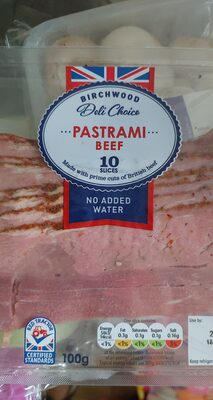
Pastrami Beef
Nutrition per 100 g
| Nutrient | Cured and cooked, formed bee... | Pastrami Beef |
|---|---|---|
| Nutri-Score | c | e |
| NOVA group | — | — |
| Calories | 142 kcal | 127 kcal |
| Fat | 4.6 g | 3.1 g |
| Saturated fat | 1.8 g | 1.1 g |
| Sugars | 1.1 g | 1 g |
| Salt | 1.6 g | 4.1 g |
| Fiber | 0.5 g | — |
| Protein | 23.7 g | 23 g |
| Additives | 0 | 0 |
| Allergens | Beef | None listed |
Green = better value for that nutrient (less sugar, fat, salt and calories; more fiber and protein).
Key differences
- Pastrami Beef has 11% fewer calories (127 kcal vs 142 kcal).
- Pastrami Beef has 33% less fat (3.1 g vs 4.6 g).
- Pastrami Beef has 39% less saturated fat (1.1 g vs 1.8 g).
- Cured and cooked, formed beef pastrami slices has 61% less salt (1.6 g vs 4.1 g).
- Cured and cooked, formed beef pastrami slices has the better Nutri-Score.
- Only Cured and cooked, formed beef pastrami slices lists: Beef.
Ingredients
Cured and cooked, formed beef pastrami slices
BEEF Sainsbury's Taste the Difference Serving suggestion PASTRAMI BEEF SLICES New York deli style cured beef brisket, lightly seasoned with coriander, paprika and black pepper ENERGY FAT RACK SALT 17641 414004059049 && 46 % of the Relence istakes Typicals per 100g Energy SKATTE D IN POFE Keep refrigerated Use by Produced in the UK British beef
Pastrami Beef
Not available.
FAQ
Which is healthier: Cured and cooked, formed beef pastrami slices or Pastrami Beef?
Neither product is clearly better overall — it depends on what matters most to you. We compare Nutri-Score, processing level and seven nutrients per 100 g. Your own needs (for example low sugar or high protein) may make a different choice better for you.
Which has fewer calories?
Pastrami Beef has fewer calories: 127 kcal versus 142 kcal per 100 g.
Which has less sugar?
Pastrami Beef has less sugar: 1 g versus 1.1 g per 100 g.