
20% fat beef mince vs Lean Beef Steak Mince
Overall, Lean Beef Steak Mince has the better nutritional profile on the measures we compare. It wins on 4 of our comparison points versus 0.

Nutrition per 100 g
| Nutrient | 20% fat beef mince | Lean Beef Steak Mince |
|---|---|---|
| Nutri-Score | — | a |
| NOVA group | — | — |
| Calories | 273 kcal | 125 kcal |
| Fat | 19.4 g | 4.2 g |
| Saturated fat | 8.5 g | 2.1 g |
| Sugars | 0.5 g | 0 g |
| Salt | — | 0.6 g |
| Fiber | — | 0 g |
| Protein | 23.7 g | 21.9 g |
| Additives | 0 | 0 |
| Allergens | None listed | None listed |
Green = better value for that nutrient (less sugar, fat, salt and calories; more fiber and protein).
Key differences
- Lean Beef Steak Mince has 54% fewer calories (125 kcal vs 273 kcal).
- Lean Beef Steak Mince has 78% less fat (4.2 g vs 19.4 g).
- Lean Beef Steak Mince has 75% less saturated fat (2.1 g vs 8.5 g).
- Lean Beef Steak Mince has no sugar, while 20% fat beef mince has 0.5 g.
Ingredients
20% fat beef mince
British 20% fat beef n... e To pan fry from chilled. If freezing at home, defrost thoroughly before cooking Bef mince we hot pan. 500g gat pan over a high heat. Remove packaging and place During Cooking: Use a wooden spoon to break down mince in the pan. Pan fry over a high heat for 5-6 Minutes Stir frequently Drain fat off halfway through After Cooking: Check food is piping hot, and no pink colour remains All cooking appliances vary. This is a guide only For use by date: see front of pack Keep refrigerated.
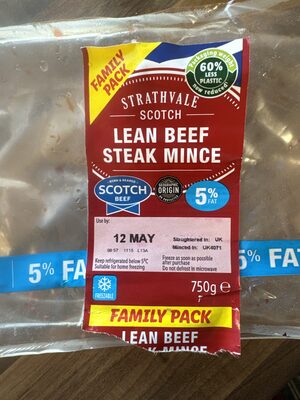
Lean Beef Steak Mince
Scotch beef mince
FAQ
Which is healthier: 20% fat beef mince or Lean Beef Steak Mince?
Overall, Lean Beef Steak Mince has the better nutritional profile on the measures we compare. We compare Nutri-Score, processing level and seven nutrients per 100 g. Your own needs (for example low sugar or high protein) may make a different choice better for you.
Which has fewer calories?
Lean Beef Steak Mince has fewer calories: 125 kcal versus 273 kcal per 100 g.
Which has less sugar?
Lean Beef Steak Mince has less sugar: 0 g versus 0.5 g per 100 g.