
Pechuga de Pavo Cocida Bajo Contenido el Sal vs Trutenbrust hauchdünn
Neither product is clearly better overall — it depends on what matters most to you.
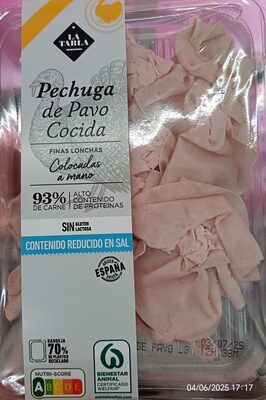
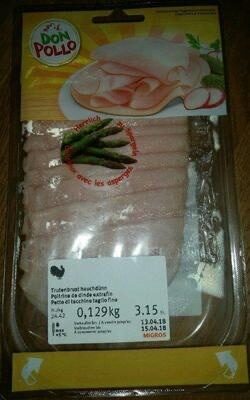
Nutrition per 100 g
| Nutrient | Pechuga de Pavo Cocida Bajo... | Trutenbrust hauchdünn |
|---|---|---|
| Nutri-Score | a | d |
| NOVA group | 4 | 4 |
| Calories | 107 kcal | 63 kcal |
| Fat | 1.1 g | 1 g |
| Saturated fat | 0.4 g | 0.3 g |
| Sugars | 1 g | 0.5 g |
| Salt | 1.3 g | 2.2 g |
| Fiber | 0 g | 0.5 g |
| Protein | 23 g | 21 g |
| Additives | 5 | 4 |
| Allergens | None listed | None listed |
Green = better value for that nutrient (less sugar, fat, salt and calories; more fiber and protein).
Key differences
- Trutenbrust hauchdünn has 41% fewer calories (63 kcal vs 107 kcal).
- Trutenbrust hauchdünn has 50% less sugar (0.5 g vs 1 g).
- Pechuga de Pavo Cocida Bajo Contenido el Sal has 41% less salt (1.3 g vs 2.2 g).
- Trutenbrust hauchdünn has 100% more fiber (0.5 g vs 0 g).
- Pechuga de Pavo Cocida Bajo Contenido el Sal has the better Nutri-Score.
Ingredients
Pechuga de Pavo Cocida Bajo Contenido el Sal
Pechuga de pavo (93%), sal, jarabe de glucosa, gelificante (E407), azúcar, estabilizante (E451), sal potásica, aroma, fibra vegetal, antioxidante (E301), conservador (E243,E250), extractos de especias.
Trutenbrust hauchdünn
Trutenfleisch (Brasilien, Frankreich, Ungarn, Polen) 90%, Wasser, Nitrit. pokelsalz (jodiertes Kochsalz, Konservierungsstoff: E 250), Würze (enthalt Hefe extrakt), Glucosesirup, Antioxidationsmittel: E 301 und 591, Saureregulator 500, Stabilisatoren: E 450 und E 451, Verdickungsmittel: Johannisbrotkernmeti und E 4078.
FAQ
Which is healthier: Pechuga de Pavo Cocida Bajo Contenido el Sal or Trutenbrust hauchdünn?
Neither product is clearly better overall — it depends on what matters most to you. We compare Nutri-Score, processing level and seven nutrients per 100 g. Your own needs (for example low sugar or high protein) may make a different choice better for you.
Which has fewer calories?
Trutenbrust hauchdünn has fewer calories: 63 kcal versus 107 kcal per 100 g.
Which has less sugar?
Trutenbrust hauchdünn has less sugar: 0.5 g versus 1 g per 100 g.