
Low Sodium 100% Vegetable Juice vs 100% pur jus légumes
Overall, 100% pur jus légumes has the better nutritional profile on the measures we compare. It wins on 3 of our comparison points versus 2.
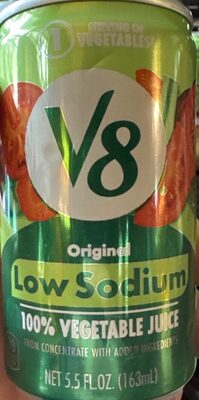
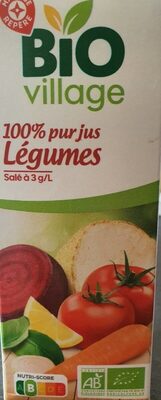
Nutrition per 100 ml
| Nutrient | Low Sodium 100% Vegetable Ju... | 100% pur jus légumes |
|---|---|---|
| Nutri-Score | c | b |
| NOVA group | 4 | 3 |
| Calories | 18 kcal | 18 kcal |
| Fat | 0 g | 0.5 g |
| Saturated fat | 0 g | 0.1 g |
| Sugars | 3.1 g | 3.7 g |
| Salt | 0.2 g | 0.3 g |
| Fiber | 0.6 g | 0.5 g |
| Protein | 0.6 g | 0.7 g |
| Additives | 1 | 0 |
| Allergens | Celery | None listed |
Green = better value for that nutrient (less sugar, fat, salt and calories; more fiber and protein).
Key differences
- Low Sodium 100% Vegetable Juice has no fat, while 100% pur jus légumes has 0.5 g.
- Low Sodium 100% Vegetable Juice has 17% less sugar (3.1 g vs 3.7 g).
- 100% pur jus légumes has the better Nutri-Score.
- 100% pur jus légumes is less processed (lower NOVA group).
- Only Low Sodium 100% Vegetable Juice lists: Celery.
Ingredients
Low Sodium 100% Vegetable Juice
VEGETABLE JUICE (WATER AND CONCENTRATED JUICES OF TOMATOES, CARROTS, CELERY, BEETS, PARSLEY, LETTUCE, WATERCRESS, SPINÁCH), POTASSIUM CHLORIDE, SALT, VITAMIN C (ASCORBIC ACID), NATURAL FLAVORING, BETA CAROTENE, CITRIC ACID.
100% pur jus légumes
Jus de tomate* 62 %, jus de carotte* 20 %, jus de célerl* 7,8 %, jus de betterave* 7,8%, jus de citron, jus d'oignon+ 1,3%, sel, extrait de basilic, poivre*. *Ingrédients issus de l'agriculture biologique.
FAQ
Which is healthier: Low Sodium 100% Vegetable Juice or 100% pur jus légumes?
Overall, 100% pur jus légumes has the better nutritional profile on the measures we compare. We compare Nutri-Score, processing level and seven nutrients per 100 g. Your own needs (for example low sugar or high protein) may make a different choice better for you.
Which has fewer calories?
100% pur jus légumes has fewer calories: 18 kcal versus 18 kcal per 100 g.
Which has less sugar?
Low Sodium 100% Vegetable Juice has less sugar: 3.1 g versus 3.7 g per 100 g.