
Jambon Supérieur Avec couenne vs Jambon cuit supérieur
Overall, Jambon cuit supérieur has the better nutritional profile on the measures we compare. It wins on 4 of our comparison points versus 1.
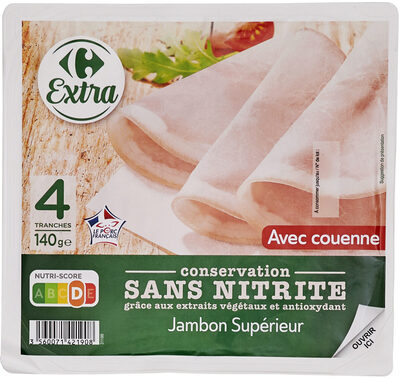
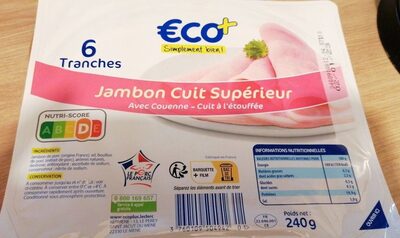
Nutrition per 100 g
| Nutrient | Jambon Supérieur Avec couenn... | Jambon cuit supérieur |
|---|---|---|
| Nutri-Score | d | d |
| NOVA group | 4 | 4 |
| Calories | 156 kcal | 138 kcal |
| Fat | 8 g | 6.3 g |
| Saturated fat | 3.1 g | 2.3 g |
| Sugars | 1 g | 0.5 g |
| Salt | 1.8 g | 1.9 g |
| Fiber | 0.5 g | 0 g |
| Protein | 20 g | 19.9 g |
| Additives | 1 | 2 |
| Allergens | None | None listed |
Green = better value for that nutrient (less sugar, fat, salt and calories; more fiber and protein).
Key differences
- Jambon cuit supérieur has 12% fewer calories (138 kcal vs 156 kcal).
- Jambon cuit supérieur has 21% less fat (6.3 g vs 8 g).
- Jambon cuit supérieur has 26% less saturated fat (2.3 g vs 3.1 g).
- Jambon cuit supérieur has 50% less sugar (0.5 g vs 1 g).
- Jambon Supérieur Avec couenne has 100% more fiber (0.5 g vs 0 g).
- Only Jambon Supérieur Avec couenne lists: None.
Ingredients
Jambon Supérieur Avec couenne
Jambon de porc, couenne et gras de porc, eau, sel, dextrose, arômes naturels (présence naturelle de polyphénols), bouillon (eau, arôme naturel, oignon, ail, poivre noir, noix de muscade, clou de girofle, thym, laurier), antioxydant : acide ascorbique. Viande de porc origine France.
Jambon cuit supérieur
Jambon de porc (origine France), sel, bouillon de porc (extrait de porc), arômes naturels, dextrose, antioxydant : ascorbate de sodium, conservateur : nitrite de sodium.
FAQ
Which is healthier: Jambon Supérieur Avec couenne or Jambon cuit supérieur?
Overall, Jambon cuit supérieur has the better nutritional profile on the measures we compare. We compare Nutri-Score, processing level and seven nutrients per 100 g. Your own needs (for example low sugar or high protein) may make a different choice better for you.
Which has fewer calories?
Jambon cuit supérieur has fewer calories: 138 kcal versus 156 kcal per 100 g.
Which has less sugar?
Jambon cuit supérieur has less sugar: 0.5 g versus 1 g per 100 g.