
Haché au bœuf vs Le Super Tendre à l'oignon
Overall, Haché au bœuf has the better nutritional profile on the measures we compare. It wins on 3 of our comparison points versus 0.
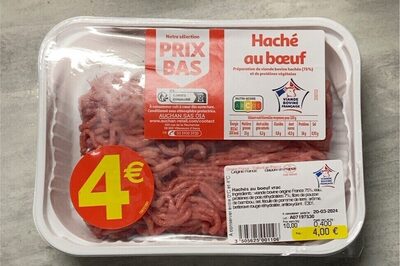
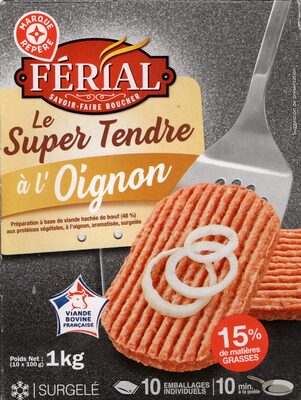
Nutrition per 100 g
| Nutrient | Haché au bœuf | Le Super Tendre à l'oignon |
|---|---|---|
| Nutri-Score | d | d |
| NOVA group | 3 | 4 |
| Calories | 205 kcal | 211 kcal |
| Fat | 15 g | 15 g |
| Saturated fat | 6.3 g | 6.8 g |
| Sugars | 0.4 g | 1.1 g |
| Salt | 0.9 g | 0.7 g |
| Fiber | — | 1.7 g |
| Protein | 16 g | 13 g |
| Additives | 1 | 0 |
| Allergens | None listed | Gluten, Soybeans |
Green = better value for that nutrient (less sugar, fat, salt and calories; more fiber and protein).
Key differences
- Haché au bœuf has 64% less sugar (0.4 g vs 1.1 g).
- Haché au bœuf has 19% more protein (16 g vs 13 g).
- Haché au bœuf is less processed (lower NOVA group).
- Only Le Super Tendre à l'oignon lists: Gluten, Soybeans.
Ingredients
Haché au bœuf
Viande bovine origine France 75%, eau proteines de pois réhydratées 7% fibre de pousse de bambou, sel, fecule de pomme de terre arome, betterave rouge réhydratée, antioxydant: E301.
Le Super Tendre à l'oignon
Le super tendre a l'oignon viande de boeuf (48%), proteines de {allergene}soja{/allergene} rehydratees (30%), eau, oignons rehydrates (4%), gras de boeuf, chapelure ({allergene}ble{/allergene}), sel, aromes, maltodextrine, betterave rouge deshydratee. {traces}traces d'oeuf, lait, gluten. pourcentage de matieres grasses inferieur a 15%. rapport collagene sur proteines de viande inferieur a 15%. ce produit ne contient que de la viande de bovins, nes, eleves et abattus en france. elabore en france.{/traces}
FAQ
Which is healthier: Haché au bœuf or Le Super Tendre à l'oignon?
Overall, Haché au bœuf has the better nutritional profile on the measures we compare. We compare Nutri-Score, processing level and seven nutrients per 100 g. Your own needs (for example low sugar or high protein) may make a different choice better for you.
Which has fewer calories?
Haché au bœuf has fewer calories: 205 kcal versus 211 kcal per 100 g.
Which has less sugar?
Haché au bœuf has less sugar: 0.4 g versus 1.1 g per 100 g.