
Salami de dinde vs Geflügel-Salami
Overall, Geflügel-Salami has the better nutritional profile on the measures we compare. It wins on 2 of our comparison points versus 0.
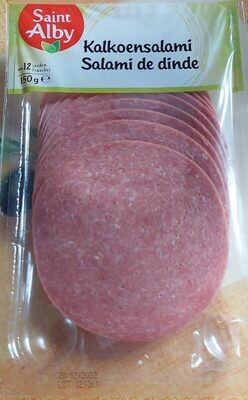
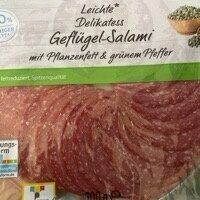
Nutrition per 100 g
| Nutrient | Salami de dinde | Geflügel-Salami |
|---|---|---|
| Nutri-Score | e | e |
| NOVA group | 4 | — |
| Calories | 221 kcal | 227 kcal |
| Fat | 14.5 g | 15 g |
| Saturated fat | 5.6 g | 6.1 g |
| Sugars | 1.8 g | 1 g |
| Salt | 3.4 g | 3.7 g |
| Fiber | — | 0 g |
| Protein | 19.3 g | 22 g |
| Additives | 5 | 0 |
| Allergens | None listed | None listed |
Green = better value for that nutrient (less sugar, fat, salt and calories; more fiber and protein).
Key differences
- Geflügel-Salami has 44% less sugar (1 g vs 1.8 g).
- Geflügel-Salami has 12% more protein (22 g vs 19.3 g).
Ingredients
Salami de dinde
c be turkey salami, smoked, sliced, ingredients: turkey meat, salt, glucose syrup, dextrose, pea flour, spices, spices, spice extracts, garlic, flavouring, stabiliser: sodium alginate, antioxidants: ascorbic acid, sodium ascorbate, preservative: l dl average nutritional value/ valeurs nutritionnelles moyennes redmi note 2 dro energy/energy fats/matières grasses of which saturated fatty acids/ dont acides grass saturés carbohydrates/glucides of which sugars/don't sucres proteins/ protein salt/sel sodium nitrite, colour: beet red, ferments, smoke, 100 g salami is prepared from 102 g turkey meat, store refrigerated at max, 7°c, unopened, to be used until: see top, packed under protective atmosphere, g/100 g 922 kj/
Geflügel-Salami
Not available.
FAQ
Which is healthier: Salami de dinde or Geflügel-Salami?
Overall, Geflügel-Salami has the better nutritional profile on the measures we compare. We compare Nutri-Score, processing level and seven nutrients per 100 g. Your own needs (for example low sugar or high protein) may make a different choice better for you.
Which has fewer calories?
Salami de dinde has fewer calories: 221 kcal versus 227 kcal per 100 g.
Which has less sugar?
Geflügel-Salami has less sugar: 1 g versus 1.8 g per 100 g.