
Nestle coffee-mate coffee creamer canister vs Coffee Mate
Overall, Nestle coffee-mate coffee creamer canister has the better nutritional profile on the measures we compare. It wins on 2 of our comparison points versus 1.
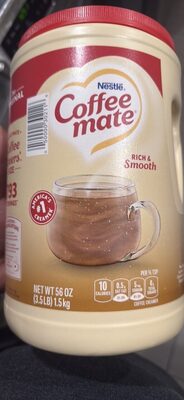
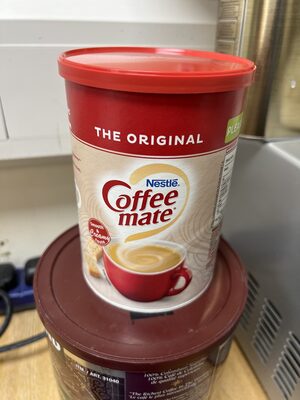
Nutrition per 100 g
| Nutrient | Nestle coffee-mate coffee cr... | Coffee Mate |
|---|---|---|
| Nutri-Score | e | — |
| NOVA group | 4 | 4 |
| Calories | 500 kcal | 535 kcal |
| Fat | 25 g | 32.2 g |
| Saturated fat | 25 g | 24.2 g |
| Sugars | 0 g | 9.5 g |
| Salt | 0.6 g | 0.9 g |
| Fiber | 0 g | 0 g |
| Protein | 0 g | 1.6 g |
| Additives | 3 | 8 |
| Allergens | None listed | Milk |
Green = better value for that nutrient (less sugar, fat, salt and calories; more fiber and protein).
Key differences
- Nestle coffee-mate coffee creamer canister has 22% less fat (25 g vs 32.2 g).
- Nestle coffee-mate coffee creamer canister has no sugar, while Coffee Mate has 9.5 g.
- Coffee Mate has 100% more protein (1.6 g vs 0 g).
- Only Coffee Mate lists: Milk.
Ingredients
Nestle coffee-mate coffee creamer canister
CORN SYRUP SOLIDS, HYDROGENATED VEGETABLE OIL (COCONUT AND/OR PALM KERNEL AND/OR SOYBEAN), AND LESS THAN 2% OF SODIUM CASEINATE (A MILK DERIVATIVE) . MONO-AND AND ARTIFICIAL FLAVOR, ANNATTO COLOR. SODIUM ALUMINOSILICATE, NATURAL CONTAINS: A MILK DERIVATIVE.
Coffee Mate
glucose syrup, palm kernel oil, milk proteins, stabilisers (e331, e452), acidity regulator (e340), emulsifiers (e471, e472e), anti-caking agent (e170), colour (riboflavin)
FAQ
Which is healthier: Nestle coffee-mate coffee creamer canister or Coffee Mate?
Overall, Nestle coffee-mate coffee creamer canister has the better nutritional profile on the measures we compare. We compare Nutri-Score, processing level and seven nutrients per 100 g. Your own needs (for example low sugar or high protein) may make a different choice better for you.
Which has fewer calories?
Nestle coffee-mate coffee creamer canister has fewer calories: 500 kcal versus 535 kcal per 100 g.
Which has less sugar?
Nestle coffee-mate coffee creamer canister has less sugar: 0 g versus 9.5 g per 100 g.