
Fettuccine Alfredo vs Tagliatelle Wildlachs
Overall, Tagliatelle Wildlachs has the better nutritional profile on the measures we compare. It wins on 3 of our comparison points versus 2.
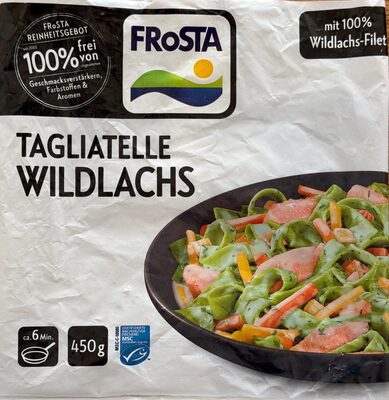
Nutrition per 100 g
| Nutrient | Fettuccine Alfredo | Tagliatelle Wildlachs |
|---|---|---|
| Nutri-Score | c | c |
| NOVA group | 3 | 3 |
| Calories | 480 kcal | 93 kcal |
| Fat | 22 g | 3.3 g |
| Saturated fat | 2 g | 1.6 g |
| Sugars | 1.6 g | 1.8 g |
| Salt | 0.8 g | 0.7 g |
| Fiber | 5.6 g | 1.4 g |
| Protein | 5.6 g | 4.8 g |
| Additives | 0 | 0 |
| Allergens | Eggs, Gluten, Milk | Eggs, Gluten, Milk |
Green = better value for that nutrient (less sugar, fat, salt and calories; more fiber and protein).
Key differences
- Tagliatelle Wildlachs has 81% fewer calories (93 kcal vs 480 kcal).
- Tagliatelle Wildlachs has 85% less fat (3.3 g vs 22 g).
- Tagliatelle Wildlachs has 20% less saturated fat (1.6 g vs 2 g).
- Fettuccine Alfredo has 75% more fiber (5.6 g vs 1.4 g).
- Fettuccine Alfredo has 14% more protein (5.6 g vs 4.8 g).
Ingredients
Fettuccine Alfredo
Pasta (Water, Lurum Wheat Semolina, Pasteurized Eggs, Salt) Sauce (Cream (Milk) Water, Hard Grating Cheese (Pasteurized Milk Salt Vegetable Rennet, Lysozyme Enzyme from Egg White), Butter (Milk) Wheat Flour, Salt,
Tagliatelle Wildlachs
Spinatnudeln 30 % (Trinkwasser, Hartweizengrieß, Spinat, Hühnerei), Wildlachsfilet 14 %, Trinkwasser, Karotten, gelbe Karotten, Schlagsahne 7 %, Vollmilch, Zwiebeln, Mehlschwitze (Weizenmehl, Sonnenblumenöl), Speisesalz, Knoblauch, Petersilie, Dill, Schnittlauch
FAQ
Which is healthier: Fettuccine Alfredo or Tagliatelle Wildlachs?
Overall, Tagliatelle Wildlachs has the better nutritional profile on the measures we compare. We compare Nutri-Score, processing level and seven nutrients per 100 g. Your own needs (for example low sugar or high protein) may make a different choice better for you.
Which has fewer calories?
Tagliatelle Wildlachs has fewer calories: 93 kcal versus 480 kcal per 100 g.
Which has less sugar?
Fettuccine Alfredo has less sugar: 1.6 g versus 1.8 g per 100 g.