
2 Naans vs 2 flame baked plain naans
Overall, 2 Naans has the better nutritional profile on the measures we compare. It wins on 4 of our comparison points versus 0.
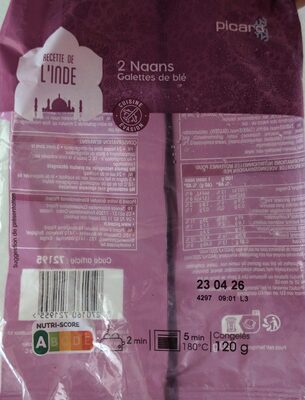

Nutrition per 100 g
| Nutrient | 2 Naans | 2 flame baked plain naans |
|---|---|---|
| Nutri-Score | c | c |
| NOVA group | 4 | 4 |
| Calories | 262 kcal | 290 kcal |
| Fat | 2.9 g | 6.1 g |
| Saturated fat | 0.3 g | 0.9 g |
| Sugars | 1.8 g | 2.4 g |
| Salt | 0.8 g | 0.9 g |
| Fiber | 3.9 g | 2.5 g |
| Protein | 8 g | 8.3 g |
| Additives | 3 | 6 |
| Allergens | Gluten, Milk, Soybeans | Gluten |
Green = better value for that nutrient (less sugar, fat, salt and calories; more fiber and protein).
Key differences
- 2 Naans has 52% less fat (2.9 g vs 6.1 g).
- 2 Naans has 67% less saturated fat (0.3 g vs 0.9 g).
- 2 Naans has 25% less sugar (1.8 g vs 2.4 g).
- 2 Naans has 36% more fiber (3.9 g vs 2.5 g).
- Only 2 Naans lists: Milk, Soybeans.
Ingredients
2 Naans
Farine de BLÉ 68,9 % (origine UE et non-UE) [farine de BLÉ (GLUTEN), carbonate de calcium, fer, niacine, thiamine], eau, huile de colza, levure, poudres à lever (diphosphates, carbonate de sodium), graine de cumin noir 0,7%, sel, cardamome moulue. Peut contenir des traces de: lait.
2 flame baked plain naans
WHEAT Flour (with Calcium Carbonate, Niacin, Iron, Thiamin), Water, Rapeseed Oil, Yeast, Spirit Vinegar, Raising Agents (Diphosphates, Sodium Carbonates, Calcium Phosphates), Vegetable Ghee (Palm Oil, Rapeseed Oil), Preservatives (Potassium Sorbate, Calcium Propionate), Kalonji Seeds, Salt, Acidity Regulator (Citric Acid), WHEAT Starch, WHEAT Flour.
FAQ
Which is healthier: 2 Naans or 2 flame baked plain naans?
Overall, 2 Naans has the better nutritional profile on the measures we compare. We compare Nutri-Score, processing level and seven nutrients per 100 g. Your own needs (for example low sugar or high protein) may make a different choice better for you.
Which has fewer calories?
2 Naans has fewer calories: 262 kcal versus 290 kcal per 100 g.
Which has less sugar?
2 Naans has less sugar: 1.8 g versus 2.4 g per 100 g.