
Overnight myrtilles vs Porridge
Overall, Overnight myrtilles has the better nutritional profile on the measures we compare. It wins on 4 of our comparison points versus 3.
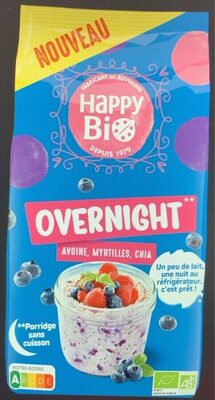
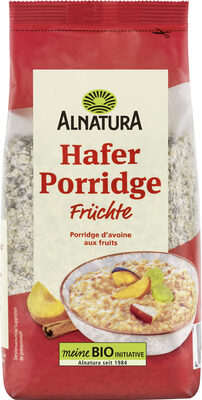
Nutrition per 100 g
| Nutrient | Overnight myrtilles | Porridge |
|---|---|---|
| Nutri-Score | a | b |
| NOVA group | 4 | 3 |
| Calories | 371 kcal | 355 kcal |
| Fat | 7.6 g | 5 g |
| Saturated fat | 1.3 g | 1 g |
| Sugars | 5.6 g | 17 g |
| Salt | 0 g | 0 g |
| Fiber | 9.9 g | 8.8 g |
| Protein | 10.8 g | 10 g |
| Additives | 2 | 0 |
| Allergens | None listed | Gluten |
Green = better value for that nutrient (less sugar, fat, salt and calories; more fiber and protein).
Key differences
- Porridge has 34% less fat (5 g vs 7.6 g).
- Porridge has 23% less saturated fat (1 g vs 1.3 g).
- Overnight myrtilles has 67% less sugar (5.6 g vs 17 g).
- Overnight myrtilles has 11% more fiber (9.9 g vs 8.8 g).
- Overnight myrtilles has the better Nutri-Score.
- Porridge is less processed (lower NOVA group).
- Only Porridge lists: Gluten.
Ingredients
Overnight myrtilles
Flocons dAVOINE* 89%, pépites de myrtilles* 6%, jus de pomme* concentré, purée de pomme" concentrée, purée de myrtille* 0,6%, sucre de canne, farine de riz", beurre de cocao", pectine, arôme naturel de myrtille, acide citrique, graines de chia 4%, myrtilles* lyophilisées 1%
Porridge
HAFERVOLLKORNFLOCKEN* 66%, Rosinen* geölt 10% (Rosinen* 99,5%, Sonnenblumenöl*), Reis* gepufft, Aprikosen* getrocknet 5%, Datteln* getrocknet 5%, Pflaumen* getrocknet 3,5%, Äpfel* getrocknet 2,5%, Reismehl*, Ceylon-Zimt* *aus biologischer Landwirtschaft. Kann Spuren von Soja, Milch, Mandel, Nüssen und Sesam enthalten.
FAQ
Which is healthier: Overnight myrtilles or Porridge?
Overall, Overnight myrtilles has the better nutritional profile on the measures we compare. We compare Nutri-Score, processing level and seven nutrients per 100 g. Your own needs (for example low sugar or high protein) may make a different choice better for you.
Which has fewer calories?
Porridge has fewer calories: 355 kcal versus 371 kcal per 100 g.
Which has less sugar?
Overnight myrtilles has less sugar: 5.6 g versus 17 g per 100 g.