
Feta - Fromage vs Greek feta Cheese
Neither product is clearly better overall — it depends on what matters most to you.
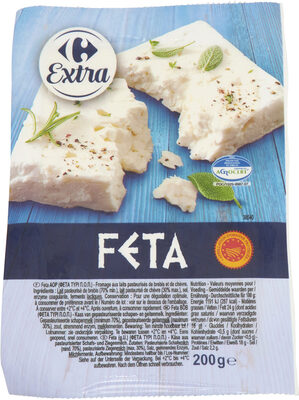
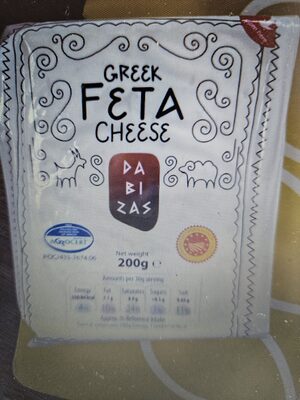
Nutrition per 100 g
| Nutrient | Feta - Fromage | Greek feta Cheese |
|---|---|---|
| Nutri-Score | d | d |
| NOVA group | 3 | — |
| Calories | 287 kcal | 281 kcal |
| Fat | 24 g | 24 g |
| Saturated fat | 16 g | 16 g |
| Sugars | 0.7 g | 0.5 g |
| Salt | 2.2 g | 2.2 g |
| Fiber | 0 g | 0.6 g |
| Protein | 18 g | 16 g |
| Additives | 0 | 0 |
| Allergens | Milk | None listed |
Green = better value for that nutrient (less sugar, fat, salt and calories; more fiber and protein).
Key differences
- Greek feta Cheese has 100% more fiber (0.6 g vs 0 g).
- Feta - Fromage has 11% more protein (18 g vs 16 g).
- Only Feta - Fromage lists: Milk.
Ingredients
Feta - Fromage
_Lait_ pasteurisé de brebis (70% min.), _lait_ pasteurisé de chèvre (30% max.), sel, enzyme coagulante, ferments _lactiques_.
Greek feta Cheese
Ingredients pasteurised sheep & goat's milk salt rennet lactic acid culture Once opened and consume within 5 days and by date shown ALLERGY ADVICE CONTAINS MU EC 50.3.20 GR
FAQ
Which is healthier: Feta - Fromage or Greek feta Cheese?
Neither product is clearly better overall — it depends on what matters most to you. We compare Nutri-Score, processing level and seven nutrients per 100 g. Your own needs (for example low sugar or high protein) may make a different choice better for you.
Which has fewer calories?
Greek feta Cheese has fewer calories: 281 kcal versus 287 kcal per 100 g.
Which has less sugar?
Greek feta Cheese has less sugar: 0.5 g versus 0.7 g per 100 g.