
Chow mein with dried seaweed laver vs Korean Ramen
Overall, Korean Ramen has the better nutritional profile on the measures we compare. It wins on 4 of our comparison points versus 0.
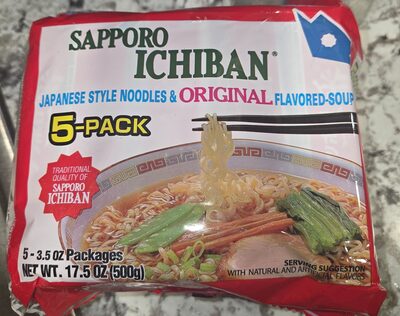
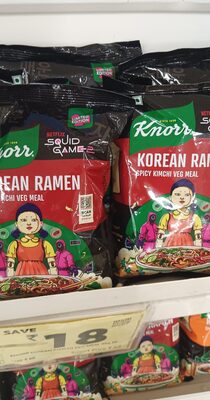
Nutrition per 100 g
| Nutrient | Chow mein with dried seaweed... | Korean Ramen |
|---|---|---|
| Nutri-Score | e | — |
| NOVA group | 4 | 4 |
| Calories | 500 kcal | 418 kcal |
| Fat | 24.5 g | 14.1 g |
| Saturated fat | 11.8 g | 6.6 g |
| Sugars | 3.9 g | 3.7 g |
| Salt | 4.7 g | 4.9 g |
| Fiber | 2.9 g | 5 g |
| Protein | 8.8 g | 9.4 g |
| Additives | 14 | 2 |
| Allergens | Gluten, Soybeans, Sulphur dioxide and sulphites | Gluten, Milk |
Green = better value for that nutrient (less sugar, fat, salt and calories; more fiber and protein).
Key differences
- Korean Ramen has 16% fewer calories (418 kcal vs 500 kcal).
- Korean Ramen has 42% less fat (14.1 g vs 24.5 g).
- Korean Ramen has 44% less saturated fat (6.6 g vs 11.8 g).
- Korean Ramen has 42% more fiber (5 g vs 2.9 g).
- Only Chow mein with dried seaweed laver lists: Soybeans, Sulphur dioxide and sulphites.
- Only Korean Ramen lists: Milk.
Ingredients
Chow mein with dried seaweed laver
Oriental noodles: enriched wheat flour (wheat flour, niacin, reduced iron, thiamine mononitrate, riboflavin, folic acid), palm oil (tbhq and citric acid added to protect flavor), salt, sodium carbonate, sugar, monosodium glutamate, tocopherols, potassium carbonate. powdered seasoning: sugar, salt, caramel color (contains sulfites), monosodium glutamate, worcestershire sauce powder ([distilled vinegar, molasses, corn syrup, salt, caramel color, garlic powder, sugar, spices, tamarind, natural flavor and sulfiting agents], maltodextrin, silicon dioxide), vinegar powder (modified corn starch, maltodextrin, vinegar solids), maltodextrin, soy sauce powder (soy sauce [water, wheat, soybeans, salt], maltodextrin, salt), sodium diacetate, citric acid, tomato powder, spices, calcium carbonate, corn oil, corn starch, annatto (for color), disodium inosinate, disodium guanylate, disodium succinate, artificial flavor. dried seaweed: laver.
Korean Ramen
NOODLES: REFINED WHEAT FLOUR (MAIDA THICKENER-1420, PALM OIL/PALMOLEIN, WHEAT GLUTEN, POTATO STARCH, IODISED SALT, YEAST, ACIDITY REGULATOR-500(i) AND 501(i), TEXTURIZER - 451(i). SEASONING: IODISED SALT, #DEHYDRATED VEGETABLES (CABBAGE, ONION, GINGER), FLAVOUR ENHANCER - 627 & 631, MILK SOLIDS, POTATO STARCH, SPICES AND CONDIMENTS (CHILLI POWDER (0.8%)), OLEORESIN CHILLI, SUGAR, MALTODEXTRIN, FLAVOURS - NATURE IDENTICAL FLAVOURING SUBSTANCES AND NATURAL GARLIC FLAVOUR, ANTICAKING AGENT - 551, HYDROLYZED VEGETABLE PROTEIN. #DEHYDRATED VEGETABLES (3.1%): CABBAGE, SPRING ONION, MUSHROOM, BROCCOLI, BELL PEPPER, ZUCCHINI. CONTAINS WHEAT AND MILK. MAY CONTAIN TRACES OF MUSTARD, CELERY, SOYA & NUTS.
FAQ
Which is healthier: Chow mein with dried seaweed laver or Korean Ramen?
Overall, Korean Ramen has the better nutritional profile on the measures we compare. We compare Nutri-Score, processing level and seven nutrients per 100 g. Your own needs (for example low sugar or high protein) may make a different choice better for you.
Which has fewer calories?
Korean Ramen has fewer calories: 418 kcal versus 500 kcal per 100 g.
Which has less sugar?
Korean Ramen has less sugar: 3.7 g versus 3.9 g per 100 g.