
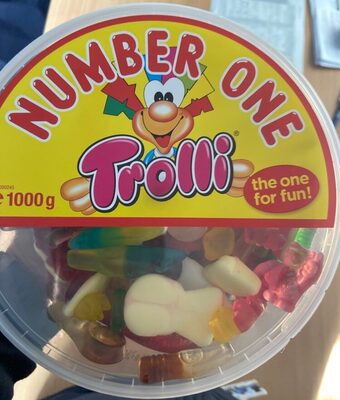
Multicoloured Fizzy Belts vs Number One
Overall, Number One has the better nutritional profile on the measures we compare. It wins on 2 of our comparison points versus 0.

Nutrition per 100 g
| Nutrient | Multicoloured Fizzy Belts | Number One |
|---|---|---|
| Nutri-Score | — | e |
| NOVA group | 4 | 4 |
| Calories | 352 kcal | 335 kcal |
| Fat | 1.6 g | 0 g |
| Saturated fat | 1.2 g | — |
| Sugars | 60.8 g | 57 g |
| Salt | — | 0.1 g |
| Fiber | 4.4 g | — |
| Protein | 2.4 g | 5.3 g |
| Additives | 5 | 7 |
| Allergens | Apple, Gluten | Apple, Gelatin |
Green = better value for that nutrient (less sugar, fat, salt and calories; more fiber and protein).
Key differences
- Number One has no fat, while Multicoloured Fizzy Belts has 1.6 g.
- Number One has 55% more protein (5.3 g vs 2.4 g).
- Only Multicoloured Fizzy Belts lists: Gluten.
- Only Number One lists: Gelatin.
Ingredients
Multicoloured Fizzy Belts
Sugar, Glucose-Fructose Syrup, Wheat Flour, Acids: Malic Acid, Citric Acid, Wheat Dextrin, Dextrose, Palm Oil, Fruit, Vegetable and Plant Concentrates (Safflower, Carrot, Hibiscus, Spirulina, Apple, Pumpkin, Tomato, Radish), Flavourings, Antioxidants: Tocopherol-Rich Extract, Ascorbic Acid
Number One
Sirop de glucose, sucre, gélatine, acidifiants: acide citrique, acide lactique, dextrose, arômes, aliments colorants (cassis, carotte noire, patate douce, radis, pomme, carotte), concentré de jus de citron, colorant: curcumine, caramel ammoniacal, bleu brillant FCF, huile de palme, agents d’enrobage: cire d'abeille, blanc et jaune, cire de camauba.
FAQ
Which is healthier: Multicoloured Fizzy Belts or Number One?
Overall, Number One has the better nutritional profile on the measures we compare. We compare Nutri-Score, processing level and seven nutrients per 100 g. Your own needs (for example low sugar or high protein) may make a different choice better for you.
Which has fewer calories?
Number One has fewer calories: 335 kcal versus 352 kcal per 100 g.
Which has less sugar?
Number One has less sugar: 57 g versus 60.8 g per 100 g.