
Fruity Jellies Kettle Cooked Soft Gummy Candy vs Sour Gummy Cockato
Overall, Sour Gummy Cockato has the better nutritional profile on the measures we compare. It wins on 4 of our comparison points versus 0.
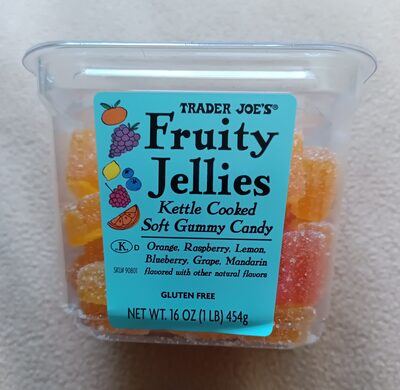
Fruity Jellies Kettle Cooked Soft Gummy Candy
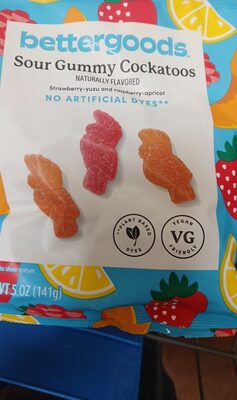
Sour Gummy Cockato
Nutrition per 100 g
| Nutrient | Fruity Jellies Kettle Cooked... | Sour Gummy Cockato |
|---|---|---|
| Nutri-Score | e | d |
| NOVA group | 4 | 4 |
| Calories | 324 kcal | 267 kcal |
| Fat | 0 g | 0 g |
| Sugars | 64.7 g | 56.7 g |
| Salt | 0 g | 0.1 g |
| Protein | 0 g | 0 g |
| Additives | 4 | 6 |
| Allergens | None listed | None listed |
Green = better value for that nutrient (less sugar, fat, salt and calories; more fiber and protein).
Key differences
- Sour Gummy Cockato has 17% fewer calories (267 kcal vs 324 kcal).
- Sour Gummy Cockato has 12% less sugar (56.7 g vs 64.7 g).
- Sour Gummy Cockato has the better Nutri-Score.
Ingredients
Fruity Jellies Kettle Cooked Soft Gummy Candy
SUGAR, GLUCOSE SYRUP (CORN), WATER, FRUIT PECTIN, CITRIC ACID (ACIDIFIER), NATURAL FLAVORS, SODIUM CITRATE, ASCORBIC ACID (TO PRESERVE), COLOR ADDED (VEGETABLE JUICE, TURMERIC), CORNSTARCH, MAY CONTAIN MILK, ALMOND, CASHEW, HAZELNUT.
Sour Gummy Cockato
SUGAR, CORN SYRUP, FOOD STARCH-MODIFIED, WATER, CITRIC ACID, MALIC ACID, SODIUM LACTATE, SODIUM HYDROGEN MALATE, NATURAL STRAWBERRY FLAVOR, NATURAL RASPBERRY FLAVOR, NATURAL APRICOT FLAVOR, NATURAL YUZU FLAVOR, CARROT CONCENTRATE (COLOR), BLACKCURRANT CONCENTRATE (COLOR), PAPRIKA OLEORESIN (COLOR)
FAQ
Which is healthier: Fruity Jellies Kettle Cooked Soft Gummy Candy or Sour Gummy Cockato?
Overall, Sour Gummy Cockato has the better nutritional profile on the measures we compare. We compare Nutri-Score, processing level and seven nutrients per 100 g. Your own needs (for example low sugar or high protein) may make a different choice better for you.
Which has fewer calories?
Sour Gummy Cockato has fewer calories: 267 kcal versus 324 kcal per 100 g.
Which has less sugar?
Sour Gummy Cockato has less sugar: 56.7 g versus 64.7 g per 100 g.