
Firecracker chicken breast slices vs Chicken Breast Fillets
Overall, Chicken Breast Fillets has the better nutritional profile on the measures we compare. It wins on 4 of our comparison points versus 1.

Firecracker chicken breast slices
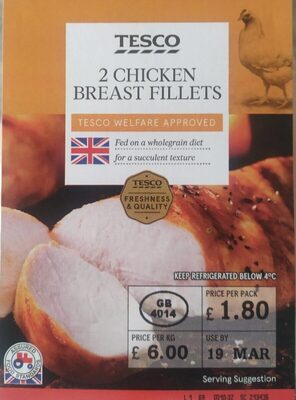
Chicken Breast Fillets
Nutrition per 100 g
| Nutrient | Firecracker chicken breast s... | Chicken Breast Fillets |
|---|---|---|
| Nutri-Score | a | a |
| NOVA group | 4 | — |
| Calories | 142 kcal | 110 kcal |
| Fat | 2.6 g | 1.4 g |
| Saturated fat | 0.7 g | 0.7 g |
| Sugars | 5.1 g | 0.1 g |
| Salt | 0.2 g | 0.1 g |
| Fiber | 0.6 g | 0.1 g |
| Protein | 20.8 g | 24.3 g |
| Additives | 4 | 0 |
| Allergens | None listed | None listed |
Green = better value for that nutrient (less sugar, fat, salt and calories; more fiber and protein).
Key differences
- Chicken Breast Fillets has 23% fewer calories (110 kcal vs 142 kcal).
- Chicken Breast Fillets has 45% less fat (1.4 g vs 2.6 g).
- Chicken Breast Fillets has 98% less sugar (0.1 g vs 5.1 g).
- Firecracker chicken breast slices has 82% more fiber (0.6 g vs 0.1 g).
- Chicken Breast Fillets has 14% more protein (24.3 g vs 20.8 g).
Ingredients
Firecracker chicken breast slices
British Chicken Breast Fillet (83%), Firecracker Marinade (13%) (Dried Glucose Syrup, Sugar, Tomato Powder, Garlic Powder, Spices (Jalapeño Chillies, Chilli Powder, Chilli, Black Pepper, Cumin), Yeast Extract, Onion Powder, Dried Carrot, Sunflower Oil, Colour: Paprika Extract, Coriander, Chipotle Extract), Sugar, Natural Mineral Salt, Potato Starch, Stabilisers: Sodium Triphosphate, Potassium Triphosphate; Chilli Powder.
Chicken Breast Fillets
Fresh Class A skinless chicken breast fillets.
FAQ
Which is healthier: Firecracker chicken breast slices or Chicken Breast Fillets?
Overall, Chicken Breast Fillets has the better nutritional profile on the measures we compare. We compare Nutri-Score, processing level and seven nutrients per 100 g. Your own needs (for example low sugar or high protein) may make a different choice better for you.
Which has fewer calories?
Chicken Breast Fillets has fewer calories: 110 kcal versus 142 kcal per 100 g.
Which has less sugar?
Chicken Breast Fillets has less sugar: 0.1 g versus 5.1 g per 100 g.