
AG1 vs Multivitamin & minerals
Neither product is clearly better overall — it depends on what matters most to you.
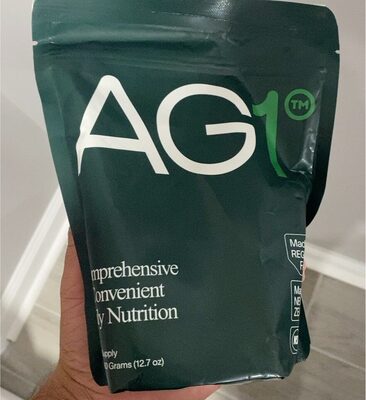
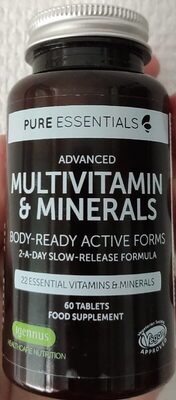
Nutrition per 100 g
| Nutrient | AG1 | Multivitamin & minerals |
|---|---|---|
| Nutri-Score | — | a |
| NOVA group | 4 | 4 |
| Calories | 250 kcal | 1 kcal |
| Fat | 0 g | 1 g |
| Saturated fat | 0 g | 1 g |
| Sugars | 4.2 g | 1 g |
| Salt | 0.9 g | 0.1 g |
| Fiber | 16.7 g | — |
| Protein | 16.7 g | 1 g |
| Additives | 3 | 5 |
| Allergens | Gluten | None listed |
Green = better value for that nutrient (less sugar, fat, salt and calories; more fiber and protein).
Key differences
- Multivitamin & minerals has 100% fewer calories (1 kcal vs 250 kcal).
- AG1 has no fat, while Multivitamin & minerals has 1 g.
- AG1 has no saturated fat, while Multivitamin & minerals has 1 g.
- Multivitamin & minerals has 76% less sugar (1 g vs 4.2 g).
- Multivitamin & minerals has 89% less salt (0.1 g vs 0.9 g).
- AG1 has 94% more protein (16.7 g vs 1 g).
- Only AG1 lists: Gluten.
Ingredients
AG1
Alkaline Nutrient-Dense Raw Superfood Complex 7388mg (Organic spirulina, lecithin, organic apple powder, inulin, organic wheat grass juice powder (leaf), organic alfalfa powder (leaf), organic chlorella powder, organic barley (Hordeum vulgare) leaf powder, acerola fruit juice powder extract, broccoli flower powder, papaya (Carica papaya) fruit powder, pineapple fruit concentrate, bilberry fruit extract, beet root powder, rose hip (Rosa canina) fruit powder, carrot root powder, spinach leaf powder, cocoa bean polyphenol extract, grape seed extract, green tea (Camellia sinensis) extract (leaf), licorice root powder, lycium berry fruit extract, ginger rhizome powder, slippery elm (Ulmus rubra) bark powder, kelp whole plant powder.), Nutrient Dense Extracts, Herbs & Antioxidants 2732mg (Alkaline pea, citric acid, rhodiola (Rhodiola rosea) root dry extract, eleuthero (Eleutherococcus senticosus) root extract, rosemary ashwagandha (Withania somnifera) root extract, dandelion whole plant dry concentrate, hawthorn berry extract, beta glucans, policosanol, Co-enzyme Q-10 (ubidecarenone), stevia (Stevia rebaudiana) leaf powder, Vitamin K2 (as menaquinone-7).), Digestive Enzyme & Super Mushroom Complex 154mg (Astragalus (Astragalus membranaceus) root powder extract, bromelain (dietary enzyme), burdock root powder, reishi mushroom powder, shiitake mushroom powder.), Dairy Free Probiotics 7.2 billion CFU 54mg (Lactobacillus acidophilus - UALa-01, Bifidobacterium bifidum - UABb-10), Natural flavors
Multivitamin & minerals
Vitamin A (as beta-carotene), Vitamin C (as ascorbic acid & ascorbyl palmitate), Vitamin D3 (as cholecalciferol), Vitamin E (as natural D-alpha-tocopherol), Vitamin K2 (as menaquinone all-trans MK-7), Thiamin (as thiamin hydrochloride; B1), Riboflavin (as riboflavin 5'-phosphate; B2), Niacin (as niacinamide [no-flush niacin)), Vitamin B6 (as pyridoxal 5'-phosphate), Folate (as calcium L-methylfolate), Vitamin B12 (as methylcobalamin), Biotin (as D-biotin), Pantothenic acid (as calcium D-pantothenate), Iron (as ferrous bisglycinate), lodine (as potassium iodide), Zinc (as bisglycinate), Selenium (as sodium selenite), Copper (as bisglycinate), Chromium (as picolinate), Molybdenum (as sodium molybdate), Boron (as boric acid), Plant cellulose, dicalcium phosphate.
FAQ
Which is healthier: AG1 or Multivitamin & minerals?
Neither product is clearly better overall — it depends on what matters most to you. We compare Nutri-Score, processing level and seven nutrients per 100 g. Your own needs (for example low sugar or high protein) may make a different choice better for you.
Which has fewer calories?
Multivitamin & minerals has fewer calories: 1 kcal versus 250 kcal per 100 g.
Which has less sugar?
Multivitamin & minerals has less sugar: 1 g versus 4.2 g per 100 g.