
Rôti de porc vs Schweinebraten
Overall, Schweinebraten has the better nutritional profile on the measures we compare. It wins on 3 of our comparison points versus 0.
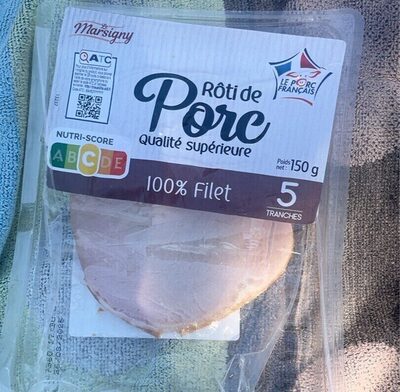
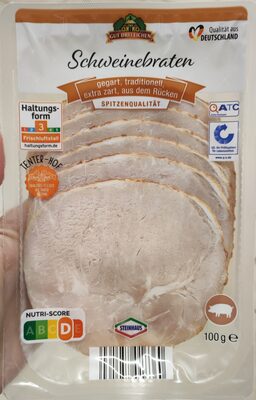
Nutrition per 100 g
| Nutrient | Rôti de porc | Schweinebraten |
|---|---|---|
| Nutri-Score | c | c |
| NOVA group | 4 | 4 |
| Calories | 120 kcal | 128 kcal |
| Fat | 3.5 g | 3 g |
| Saturated fat | 1.8 g | 1 g |
| Sugars | 0.8 g | 1 g |
| Salt | 1.8 g | 1.7 g |
| Fiber | 0 g | — |
| Protein | 21 g | 24 g |
| Additives | 3 | 3 |
| Allergens | None listed | None listed |
Green = better value for that nutrient (less sugar, fat, salt and calories; more fiber and protein).
Key differences
- Schweinebraten has 14% less fat (3 g vs 3.5 g).
- Schweinebraten has 44% less saturated fat (1 g vs 1.8 g).
- Schweinebraten has 13% more protein (24 g vs 21 g).
Ingredients
Rôti de porc
Filet de porc 99%, sel, dextrose, sirop de glucose, arôme naturel de poivre, ail, antioxydant : E301, poireau, oignon, carotte, conservateur : E250, persil, épice, plante aromatique, colorant de surface: E150a.
Schweinebraten
Schweinefleisch', jodiertes Speisesalz (Speisesalz, Kaliumjodat), Säureregulatoren: Kaliumlactat, Natrium - carbonate; Stabilisatoren: Natriumacetate, Diphosphate; Dextrose, Glukosesirup. ¹QS-Ware Kann Spuren von Senf und Gluten enthalten.
FAQ
Which is healthier: Rôti de porc or Schweinebraten?
Overall, Schweinebraten has the better nutritional profile on the measures we compare. We compare Nutri-Score, processing level and seven nutrients per 100 g. Your own needs (for example low sugar or high protein) may make a different choice better for you.
Which has fewer calories?
Rôti de porc has fewer calories: 120 kcal versus 128 kcal per 100 g.
Which has less sugar?
Rôti de porc has less sugar: 0.8 g versus 1 g per 100 g.