
Protein Drink Vanilla vs Boisson lactée saveur chocolat
Overall, Boisson lactée saveur chocolat has the better nutritional profile on the measures we compare. It wins on 3 of our comparison points versus 1.
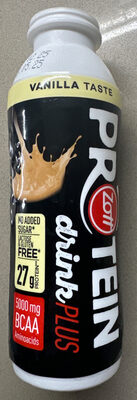
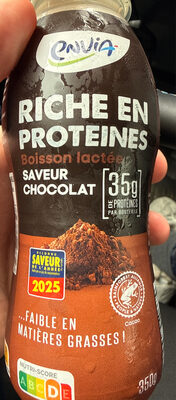
Nutrition per 100 g
| Nutrient | Protein Drink Vanilla | Boisson lactée saveur chocol... |
|---|---|---|
| Nutri-Score | — | — |
| NOVA group | — | 4 |
| Calories | 76 kcal | 67 kcal |
| Fat | 1.1 g | 0.3 g |
| Saturated fat | 0 g | 0.2 g |
| Sugars | 0 g | 5.2 g |
| Salt | 0 g | 0.2 g |
| Fiber | 0 g | 0.4 g |
| Protein | 10.8 g | 10.6 g |
| Additives | 0 | 2 |
| Allergens | None listed | Milk |
Green = better value for that nutrient (less sugar, fat, salt and calories; more fiber and protein).
Key differences
- Boisson lactée saveur chocolat has 12% fewer calories (67 kcal vs 76 kcal).
- Boisson lactée saveur chocolat has 73% less fat (0.3 g vs 1.1 g).
- Protein Drink Vanilla has no sugar, while Boisson lactée saveur chocolat has 5.2 g.
- Boisson lactée saveur chocolat has 100% more fiber (0.4 g vs 0 g).
- Only Boisson lactée saveur chocolat lists: Milk.
Ingredients
Protein Drink Vanilla
LUS بنكهة الفانيليا مع محليات معالج بدرجة حرارة عالية (UT) تاريخ (R) الصلاحية : انظر التاريخ . رقم الدفعة انظر التاريخ الي + 20 °م 4+ VANILLA FLAVOURED MILK DRINK WITH SWEETENERS. UHT. Best before: see da BRUSMAN LACTE GOUT DE VANILLE AVEC EDULCORANTS. UHT.
Boisson lactée saveur chocolat
81% latte scremato, 17% proteine del latte, 1,2% cacao magro, stabilizzante (carragenina); edulcorante (sucralosio); aroma.
FAQ
Which is healthier: Protein Drink Vanilla or Boisson lactée saveur chocolat?
Overall, Boisson lactée saveur chocolat has the better nutritional profile on the measures we compare. We compare Nutri-Score, processing level and seven nutrients per 100 g. Your own needs (for example low sugar or high protein) may make a different choice better for you.
Which has fewer calories?
Boisson lactée saveur chocolat has fewer calories: 67 kcal versus 76 kcal per 100 g.
Which has less sugar?
Protein Drink Vanilla has less sugar: 0 g versus 5.2 g per 100 g.