
Bouillon de légumes vs Gemüsebrühe
Overall, Bouillon de légumes has the better nutritional profile on the measures we compare. It wins on 5 of our comparison points versus 4.

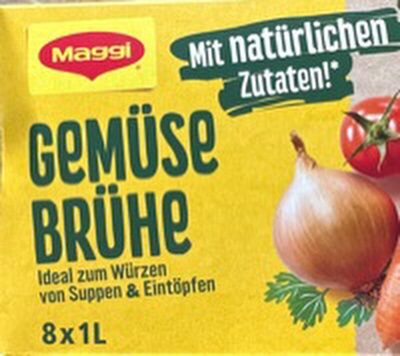
Nutrition per 100 g
| Nutrient | Bouillon de légumes | Gemüsebrühe |
|---|---|---|
| Nutri-Score | a | c |
| NOVA group | — | 4 |
| Calories | 154 kcal | 5 kcal |
| Fat | 2.8 g | 0.2 g |
| Saturated fat | 0.4 g | 0.1 g |
| Sugars | 5.1 g | 0.4 g |
| Salt | 0.1 g | 1.1 g |
| Fiber | 6.8 g | 0.1 g |
| Protein | 10.1 g | 0.1 g |
| Additives | 0 | 0 |
| Allergens | None listed | Celery, Gluten |
Green = better value for that nutrient (less sugar, fat, salt and calories; more fiber and protein).
Key differences
- Gemüsebrühe has 97% fewer calories (5 kcal vs 154 kcal).
- Gemüsebrühe has 93% less fat (0.2 g vs 2.8 g).
- Gemüsebrühe has 75% less saturated fat (0.1 g vs 0.4 g).
- Gemüsebrühe has 92% less sugar (0.4 g vs 5.1 g).
- Bouillon de légumes has 91% less salt (0.1 g vs 1.1 g).
- Bouillon de légumes has 99% more fiber (6.8 g vs 0.1 g).
- Bouillon de légumes has 99% more protein (10.1 g vs 0.1 g).
- Bouillon de légumes has the better Nutri-Score.
- Only Gemüsebrühe lists: Celery, Gluten.
Ingredients
Bouillon de légumes
Bouillon de légumes bio: Légumes* 61% (carotte* 25%, poireau* 16%, pomme de terre* 8%, oignon*, céler branche* 3,5%, potimarron*, ail*, fenouil*), pois chiche 32%, herbes/plantes et épices* 7% (thym*, romarin*, persil*, li - veche, céleri rave*, curcuma). *issu de l'agriculture biologique Ingrédient allergène
Gemüsebrühe
45,9% Würzmischung (Salz, Kurkuma, Muskatnuss, Pfeffer), Zucker, Sheafett, natürliche Aromen, 7,1 % Zwiebeln, Stärke, 4% Karotten, Lauch, SELLERIESAMEN, Kräuter (Petersilie, SELLERIEBLATTER, Lorbeer), 0,3 % Tomaten, Sonnenblumenöl*, Salz, natürliches Gemüsearoma mit anderen natürlichen Aromen, natürliches SELLERIEAROMA, natürliches Knoblaucharoma, natürliches Liebstöckelaroma, Würze (aus WEIZEN)
FAQ
Which is healthier: Bouillon de légumes or Gemüsebrühe?
Overall, Bouillon de légumes has the better nutritional profile on the measures we compare. We compare Nutri-Score, processing level and seven nutrients per 100 g. Your own needs (for example low sugar or high protein) may make a different choice better for you.
Which has fewer calories?
Gemüsebrühe has fewer calories: 5 kcal versus 154 kcal per 100 g.
Which has less sugar?
Gemüsebrühe has less sugar: 0.4 g versus 5.1 g per 100 g.